Final Year Projects
DBATU Final Year Project Guide for BE/BTech Computer and IT Students
How the DBATU final year project works for BE/BTech Computer, CSE and IT students: Phase I and Phase II credits and marks, the internship option, a Semester VII plan and software project ideas for Marathwada colleges.
6 min read · updated
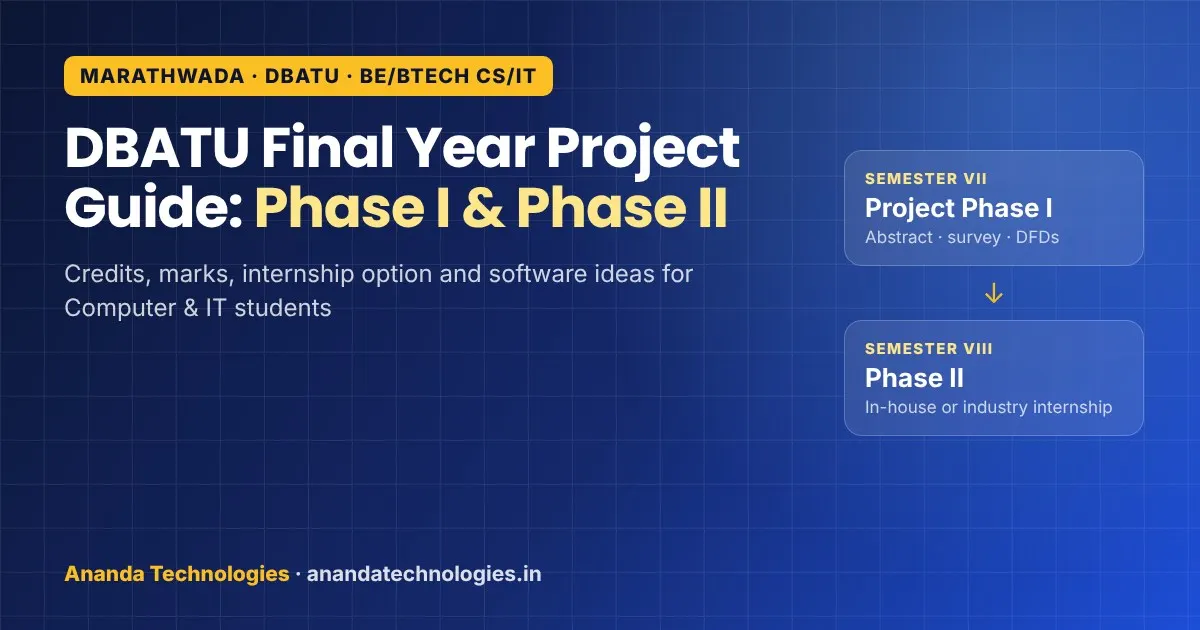
If you are in BE/BTech Computer Engineering, CSE or IT at a college affiliated to Dr. Babasaheb Ambedkar Technological University (DBATU), Lonere, your DBATU final year project runs across two semesters: Project Phase I in Semester VII and Project Phase II (or an industry internship with a project) in Semester VIII. Many engineering colleges in Chhatrapati Sambhajinagar, Latur, Nanded, Jalna and Beed follow the DBATU scheme, so this guide explains what the official syllabus says, what you should submit in each phase and how to pick a software topic you can finish on time.
All numbers below come from DBATU's own syllabus PDFs. DBATU revises its curriculum often, so always confirm the code and marks for your batch with your department.
How the DBATU final year project is structured
For current final year students, DBATU's Computer Engineering / CSE curriculum (2020–21 scheme, with the Semester VIII scheme applied from January 2024) and the Final Year IT syllabus split the project like this:
| Branch | Semester VII | Semester VIII |
|---|---|---|
| Computer Engg / CSE | BTCOS708 Project Phase I — 2 credits, 100 marks (CA 60 + ESE 40) | BTCOF801 Project Phase II (in-house) / Internship and Project in Industry — 24 hrs/week, 12 credits, 100 marks (CA 60 + ESE 40) |
| Information Technology | BTITP709 Project Phase I — 4 hrs/week, 2 credits, 50 marks | BTITP803 Project Phase II / Project with Internship — 24 hrs/week, 12 credits, 150 marks |
Two things stand out. First, Semester VIII is almost entirely the project: 12 credits for Computer Engineering, and 12 of 18 credits for IT. Second, DBATU expects many students to spend Semester VIII in an industry internship. The syllabus says students who take the internship do an industry-based project, get a department guide plus an industry guide, submit the project report to the department, and the project exam is held in consultation with the industry guide. Students who do not go for an internship do the project inside the department. For IT, the syllabus notes the internship option is six months in industry.
Note for newer batches: DBATU has also published a NEP 2020 aligned syllabus for Computer Engineering and allied programs (effective from AY 2025–26). In that scheme the final year has a Project Phase in Semester VII alongside a 12-credit internship, and Project Phase II plus Research Methodology in Semester VIII. If you were admitted under NEP, follow that structure instead and check your codes on the DBATU website.
What to finish in Project Phase I
The IT syllabus lists the Phase I work clearly, and Computer Engineering departments usually ask for the same:
- Project abstract — the problem in brief, requirements, broad area, applications and approximate cost if any.
- Detailed problem definition.
- Literature survey — current journals, reference books and online sources.
- Requirement analysis.
- System analysis — DFDs up to at least level 2.
- System design and the first 20–30% of coding.
The syllabus also says groups are of 3 or 4 students, the group should meet the guide every week in project hours, and the guide keeps a weekly record of continuous assessment. That weekly record is why consistent progress matters more than a big last-minute push.
If you want a detailed walkthrough of literature survey, SRS and design documents, our SPPU Project Stage I guide covers the same documents — the university is different, but the Phase I deliverables are very similar.
A simple plan for Semester VII
- Weeks 1–3: Shortlist 3 topics, read 8–10 recent papers or articles on each, then finalise one with your guide.
- Weeks 4–6: Write the problem definition and requirement analysis; list users, modules and data.
- Weeks 7–10: Draw DFDs (level 0, 1, 2), ER diagram and UML; freeze the database design.
- Weeks 11–14: Build login, the database and one core module so you can show 20–30% working code at the Phase I evaluation.
Project Phase II: in-house or internship?
This is the biggest decision of your final year, so decide it before Semester VII ends.
Internship route: You work in a company for the semester and do an industry-based project. Get your internship letter early, tell your department guide which project you will do, and keep a weekly log. The final report still goes to your department, so collect screenshots, architecture diagrams and test results while you are at the company — you may not have access later.
In-house route: You continue the Phase I project in college. Use the 24 hours per week to complete all modules, test them, write the report and prepare for the oral. Plan to finish coding by the middle of the semester, leaving the last weeks for testing, report writing and practice demos for your examiner.
Either way, your guide and examiner will ask why you chose your method, how the data flows and what you would improve. Our how to choose a final year project post has a checklist for picking something you can explain confidently.
Software project ideas that suit DBATU Computer and IT students
DBATU's final year Computer Engineering subjects include Artificial Intelligence, Cloud Computing, Big Data Analytics, Blockchain and Deep Learning electives; the IT syllabus includes Machine Learning, NLP, Information Security and Mobile Computing. A project that uses one of these subjects gives you more to discuss in the viva. Some ready software projects from our catalogue that fit:
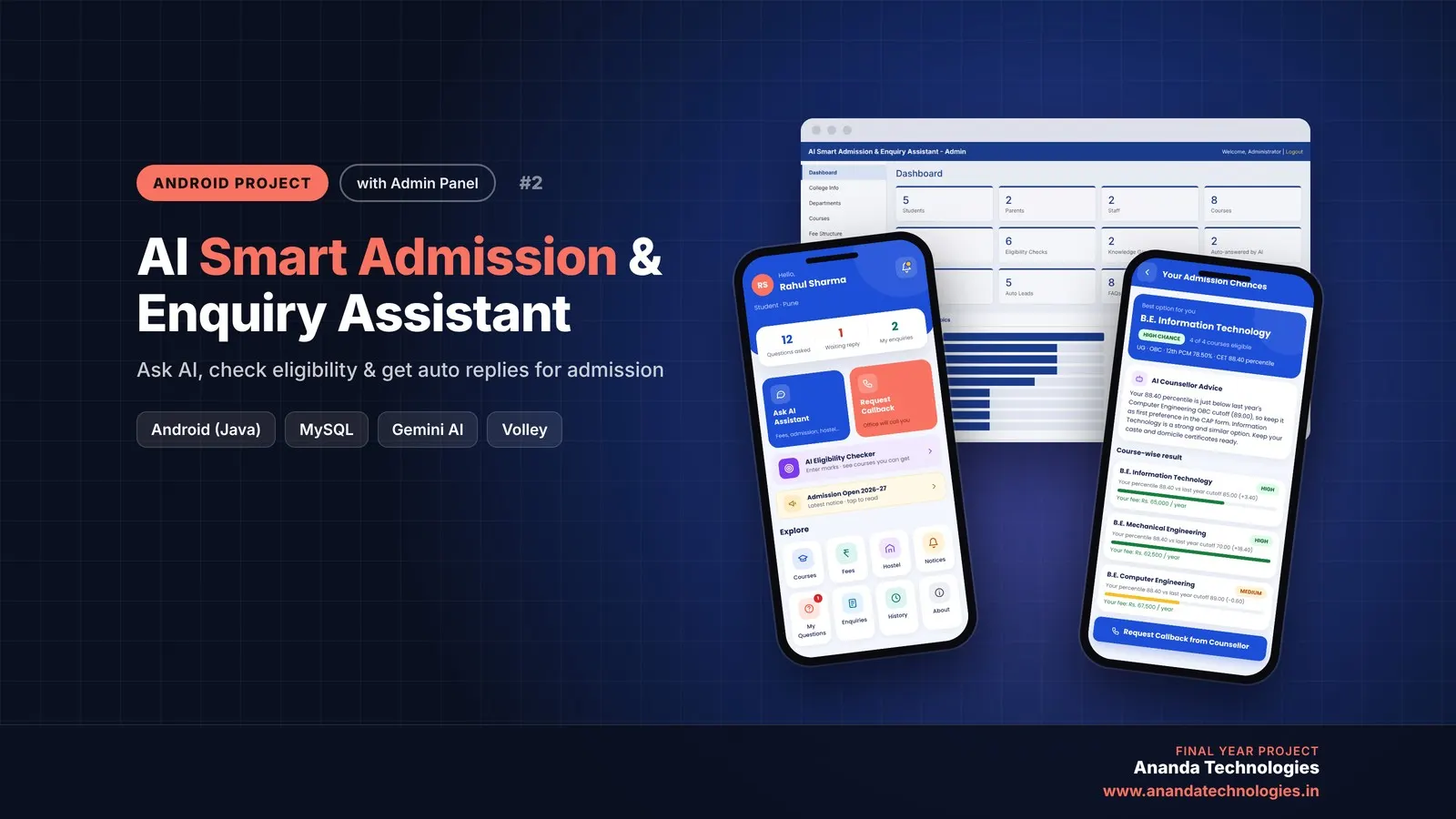
- AI and Android: AI college admission enquiry assistant with a Gemini chatbot and eligibility checker — a good fit if you studied AI or NLP.
- Deep learning on mobile: Food calorie estimation from meal photos using TensorFlow Lite to recognise Indian dishes.
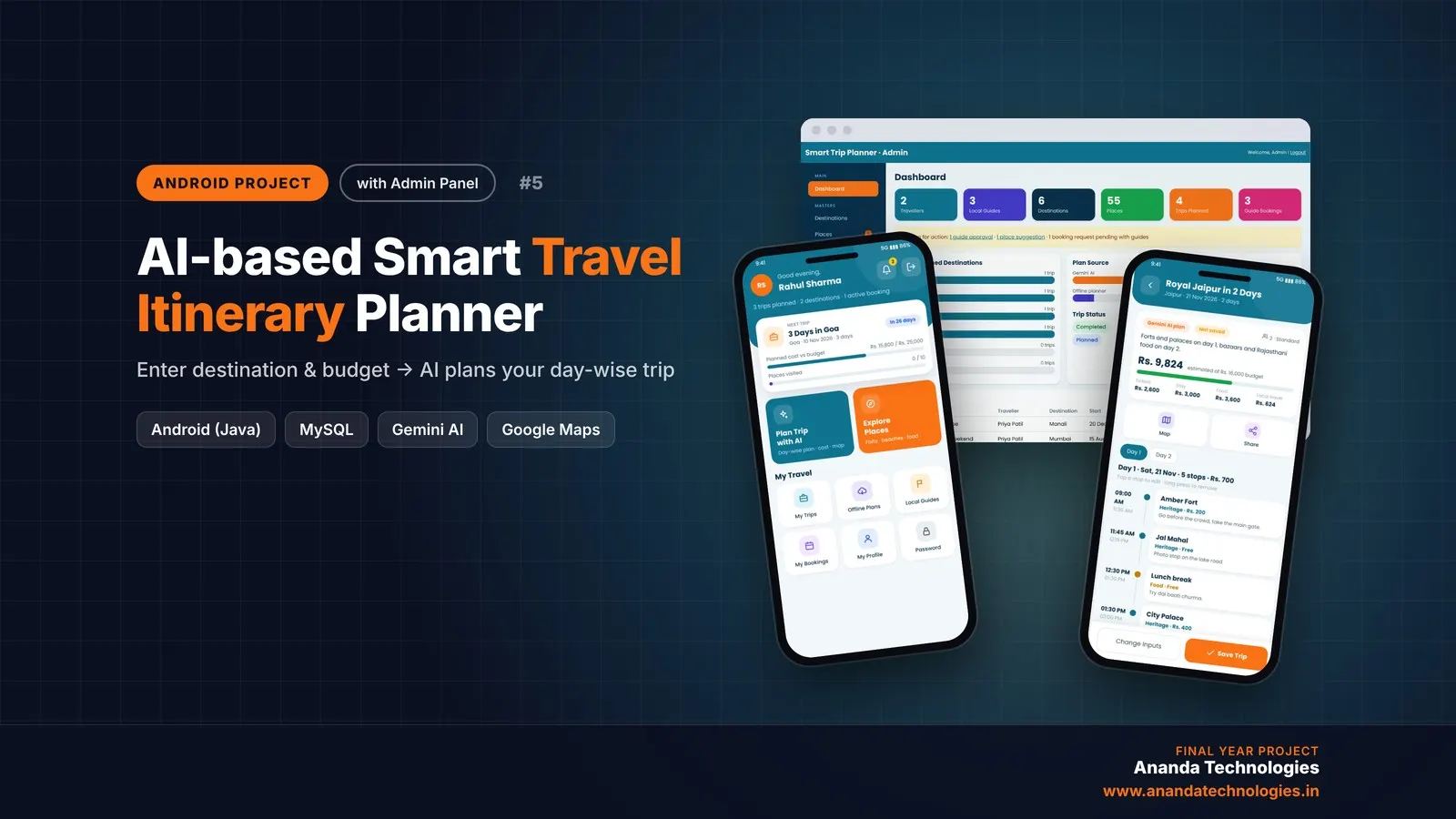
- AI planning: AI travel itinerary planner with day-wise trips, map routes and a budget tracker.
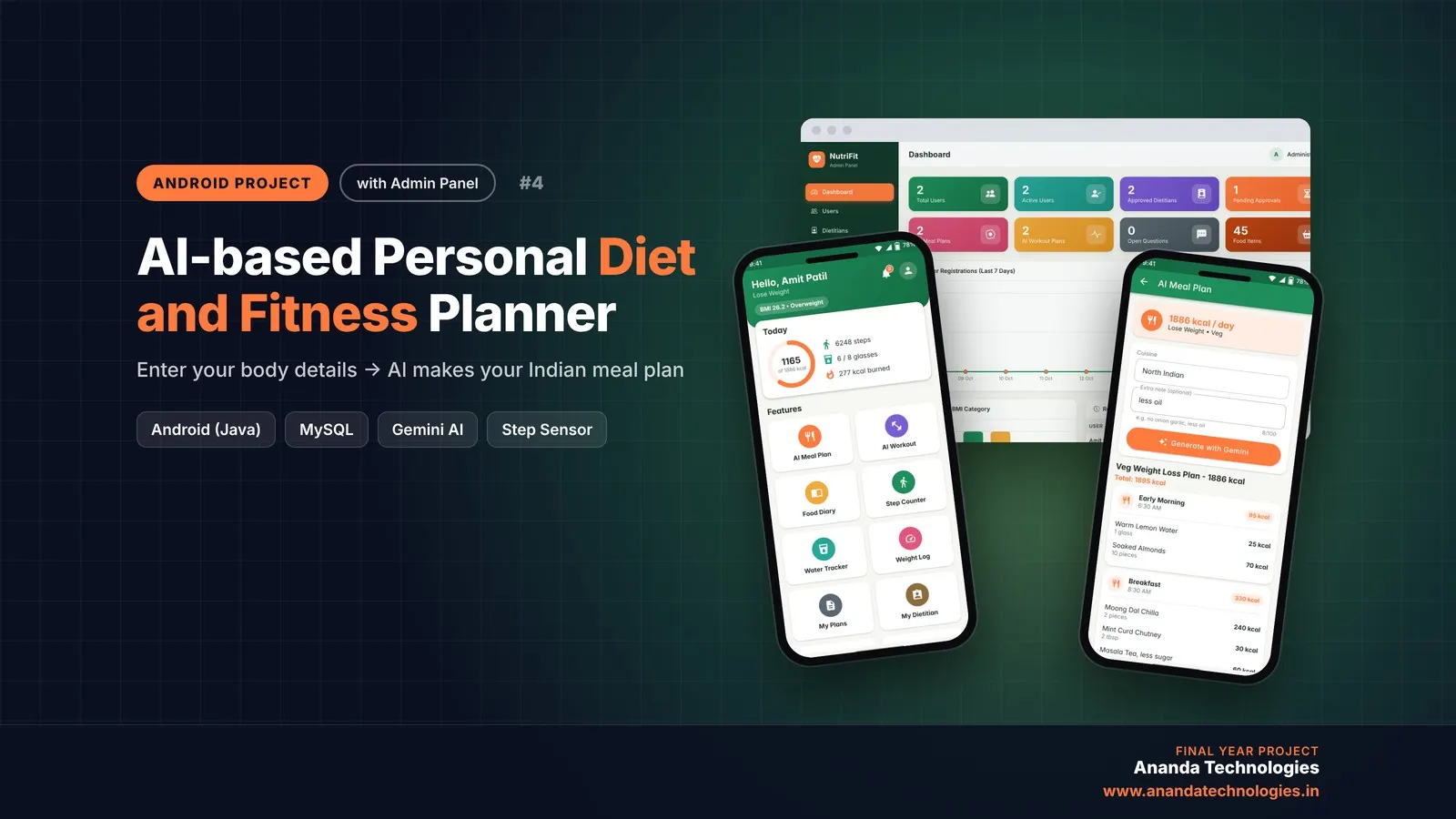
- Health and AI: AI diet and fitness planner with meal plans, a step counter and dietitian review.
- Campus systems with security: QR gate pass hostel management with rotating QR passes and a return-risk score, or the visitor gate pass system in PHP and MySQL.
- Secure web application: CampusBallot college election voting system with one-time secret ballots and live results — useful if your elective was information or network security.
- Social impact: Surplus food donation and NGO connect app linking restaurants and event halls with NGOs.
You can browse more in the BE/BTech project list, the AI and ML projects and the Android projects. Each project page has a free abstract, screenshots and a report preview so you can check the scope before you decide. We do not offer a live demo before purchase, so read the abstract and modules carefully and discuss them with your guide.
Tips from the DBATU syllabus that students often miss
- The weekly guide meeting is assessed. Continuous assessment (CA) carries 60 of 100 marks for Computer Engineering Phase I and Phase II, so attendance and steady progress count for a lot.
- Phase I is not only paperwork. The IT syllabus expects 20–30% of coding by the end of Phase I. Show something that runs.
- Keep your report in one format from day one. Ask your department for its report template early; DBATU departments usually give their own front page and certificate format.
- Pick a topic you can extend. If you take the internship route, your Phase I work may not continue into Phase II. Agree with your guide on how the two phases connect.
Help for students in Sambhajinagar, Latur, Nanded, Jalna and Beed
If you study at a DBATU-affiliated college in Marathwada and want a software topic, an abstract to discuss with your guide, or a complete project with source code and report, see our city pages for Chhatrapati Sambhajinagar, Latur, Nanded, Jalna and Beed. Pick a topic early in Semester VII, finish Phase I with working code, and Semester VIII becomes far less stressful.
Frequently asked questions
How many credits is the DBATU final year project?
In the DBATU Computer Engineering / CSE curriculum, Project Phase I (BTCOS708) in Semester VII is 2 credits and Project Phase II or Internship (BTCOF801) in Semester VIII is 12 credits. In the Final Year IT syllabus, Phase I (BTITP709) is 2 credits and Phase II / Project with Internship (BTITP803) is 12 credits. Confirm the codes for your batch with your department.
Can I do an internship instead of an in-house project in Semester VIII?
Yes. The DBATU syllabus allows students to do an industry-based project during a one-semester internship, with a department guide and an industry guide. You still submit the project report to your department. Students who do not take an internship do the project in the department.
What should be ready at the end of DBATU Project Phase I?
The IT syllabus lists the project abstract, a detailed problem definition, literature survey, requirement analysis, system analysis with DFDs up to at least level 2, system design and about 20–30% of the coding. Your guide also records your progress every week.
Which project topics suit DBATU BE/BTech Computer and IT students?
Software projects that use your final year subjects work well, for example AI chatbots, deep learning image apps, secure web portals or Android apps with a PHP and MySQL admin panel. Choose a topic you can explain in the viva, and check its free abstract, screenshots and report preview before you decide.