Final Year Projects
BE/BTech IT Final Year Project Guide and Ideas for SPPU Colleges in Pune
A guide for BE/BTech IT students in SPPU colleges: Project Stage I and II credits and marks, how to link your topic to final-year subjects, project ideas and oral tips.
6 min read · updated
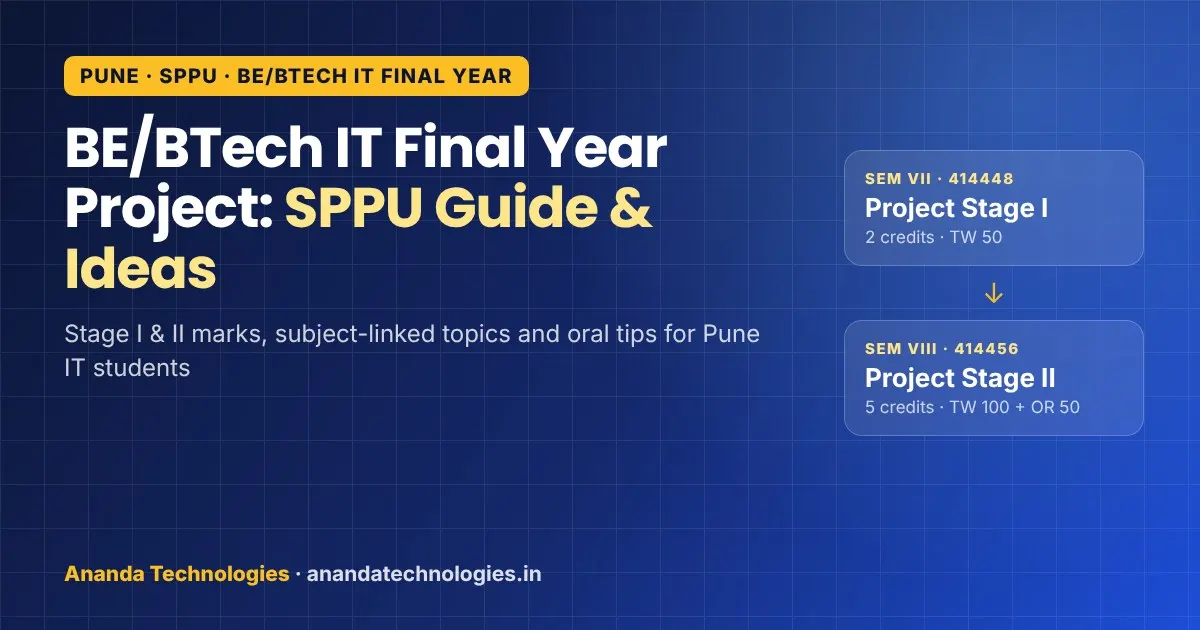
If you are planning your BTech IT final year project SPPU wants it in two parts: Project Stage I in Semester VII and Project Stage II in Semester VIII. This guide is for BE/BTech Information Technology students in Pune, Pimpri-Chinchwad and other SPPU colleges. It explains what each stage carries, how the IT syllabus can help you pick a topic, and gives project ideas that fit the subjects you already study.
All numbers below come from the SPPU Final Year Information Technology (2019 Course) structure, which applies from AY 2022-23. Newer batches admitted under the NEP pattern may get a different structure, so always check your own batch's syllabus and your department notice.
Project Stage I and Stage II at a glance
| Project Stage I | Project Stage II | |
|---|---|---|
| Course code | 414448 | 414456 |
| Semester | VII | VIII |
| Teaching hours | 2 hrs/week (tutorial) | 10 hrs/week (practical) |
| Credits | 2 | 5 |
| Marks | Term Work 50 | Term Work 100 + Oral 50 = 150 |
Two things stand out. First, Stage II has five times the weekly hours of Stage I, so most of the building happens in Semester VIII. Second, the 50-mark oral in Stage II is where examiners decide how much of the project you really understand, so every member of the group must be able to explain the code and the design.
What Stage I expects from IT students
The 2019 syllabus guidelines for Stage I say groups of preferably 3–4 students, with work reviewed by a committee that includes your guide. In short, Stage I is about proving the idea and the design:
- Review 1 – synopsis: problem statement, motivation, scope, required resources, system overview and a first architecture or DFD.
- Review 2 – requirements and design: SRS, UML and ER diagrams, detailed design, a project plan, and an early working part of the system (the guidelines mention a few working modules).
- Report and presentation: literature survey with citations, SRS, design, plan and IEEE-style references. Each student presents and answers questions.
The guidelines also talk about writing a paper on the work and checking reports for plagiarism. Colleges apply these points differently, so confirm with your guide what your department expects. For a step-by-step walk through Stage I, read our SPPU Project Stage I guide.
What Stage II expects
Stage II is where the full system is built, tested and documented. By the final review you should have:
- All modules working end to end, with real data in the database.
- Test cases and results (tables or screenshots), not just a list of features.
- A final report in your department's format, certified by your guide and HOD.
- A clear demo flow you can run in 10 minutes for the external examiner.
Our SPPU project report format guide covers the chapters and the common mistakes in the final report.
Use your Semester VII and VIII subjects to choose a topic
A smart way to pick a BE/BTech IT project is to connect it with subjects you study in the same year. Then your project, your theory exams and your oral support each other. The 2019 IT course includes these in the final year:
- Semester VII core: Information Storage and Retrieval, Software Project Management, Deep Learning.
- Elective III options: Mobile Computing, High Performance Computing, Multimedia Technology, Smart Computing.
- Elective IV options: Bioinformatics, Introduction to DevOps, Computer Vision, Wireless Communications.
- Semester VIII: Distributed Systems, plus Elective V (for example Natural Language Processing, Social Computing, Soft Computing) and Elective VI (for example Business Analytics and Intelligence, Blockchain Technology, Ethical Hacking and Security).
Your college offers only some of these electives, so match the ideas below to the ones you actually have.
BE/BTech IT project ideas linked to your subjects
Information retrieval and NLP
Search, ranking and language models are a natural fit for IT students who take Information Storage and Retrieval and NLP.
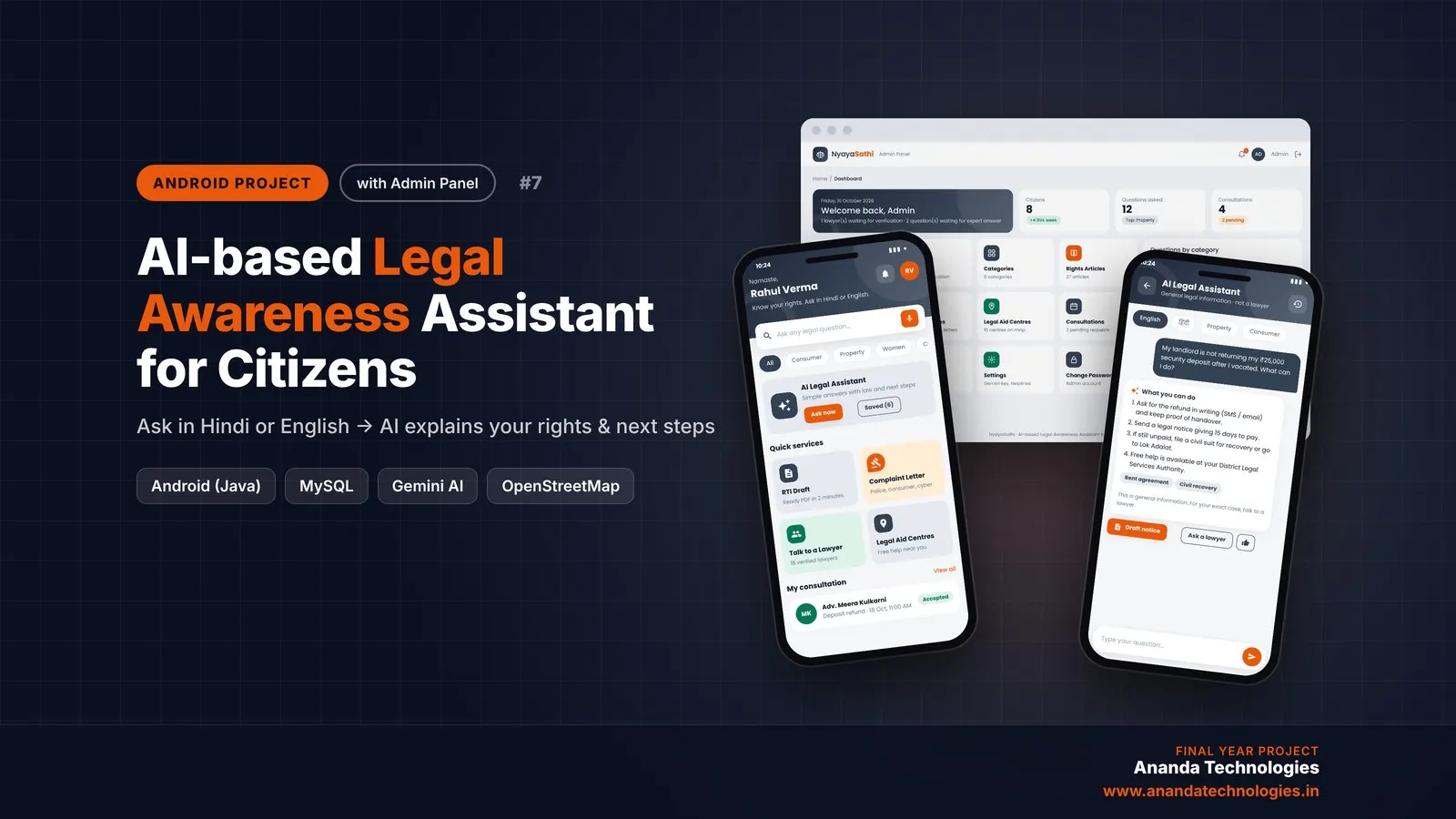
- AI Legal Awareness Assistant for Citizens – an Android app that answers legal questions in simple language (including Hindi) using Gemini, and drafts RTI applications as PDF.
- AI Spoken English Tutor – learners talk with an AI, and the app gives grammar and fluency scores, with a trainer panel.
Deep learning and computer vision
If you have Deep Learning in Semester VII and Computer Vision as an elective, an image-based project lets you show both.
- Prescription Scanner and Medicine Reminder – reads a prescription with ML Kit OCR and sets dose alarms with caretaker alerts.
- AI Recipe Generator from Ingredient Photos – snap the ingredients you have and get recipes, a meal plan and a shopping list.
Mobile computing
- College Event Management with QR e-Pass – event registration, QR passes, an entry scanner and PDF e-certificates, with an admin panel.
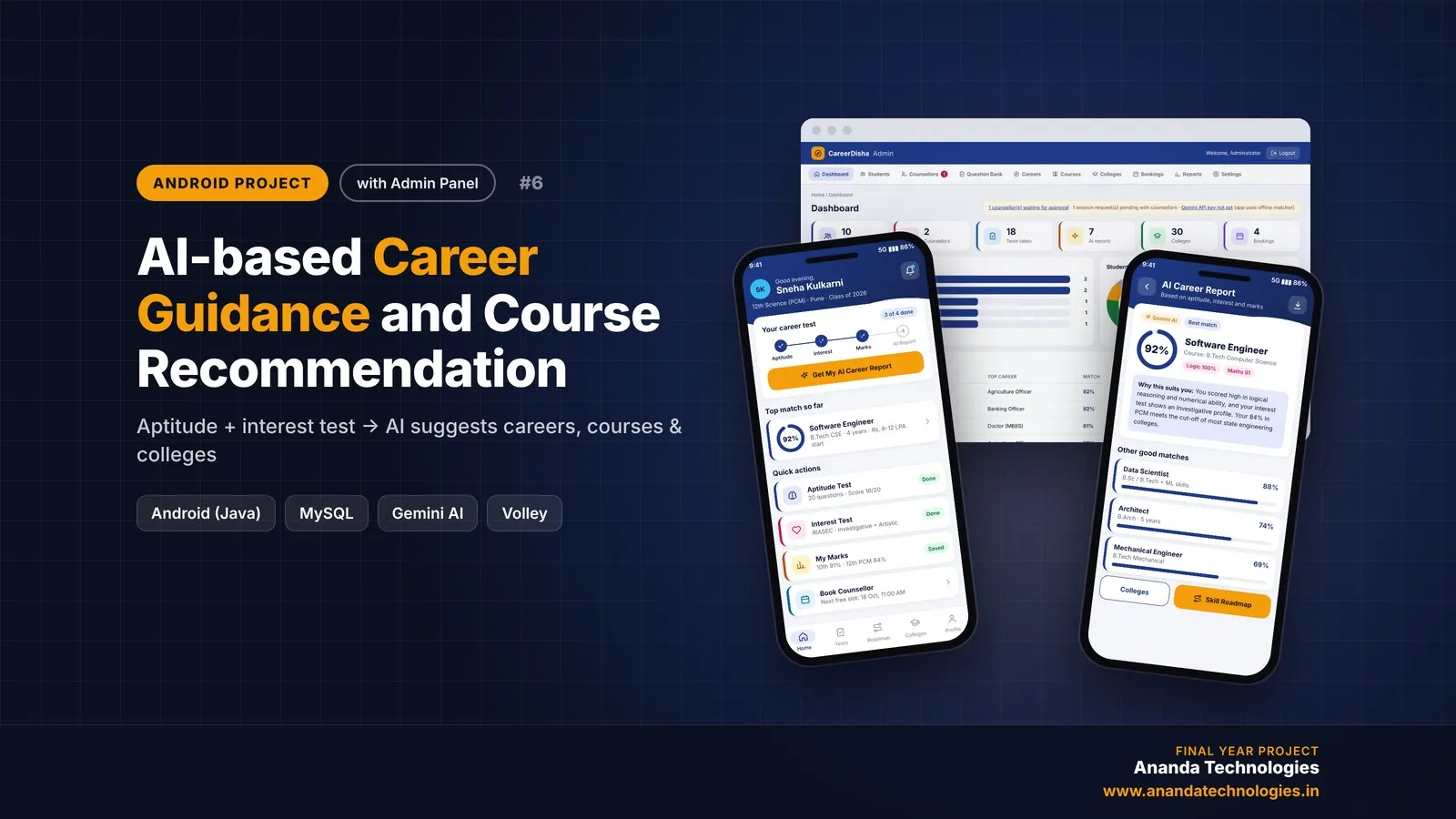
- AI Career Guidance and Course Recommendation – an aptitude and interest test that produces a career report and suggests courses.
Business analytics and software project management
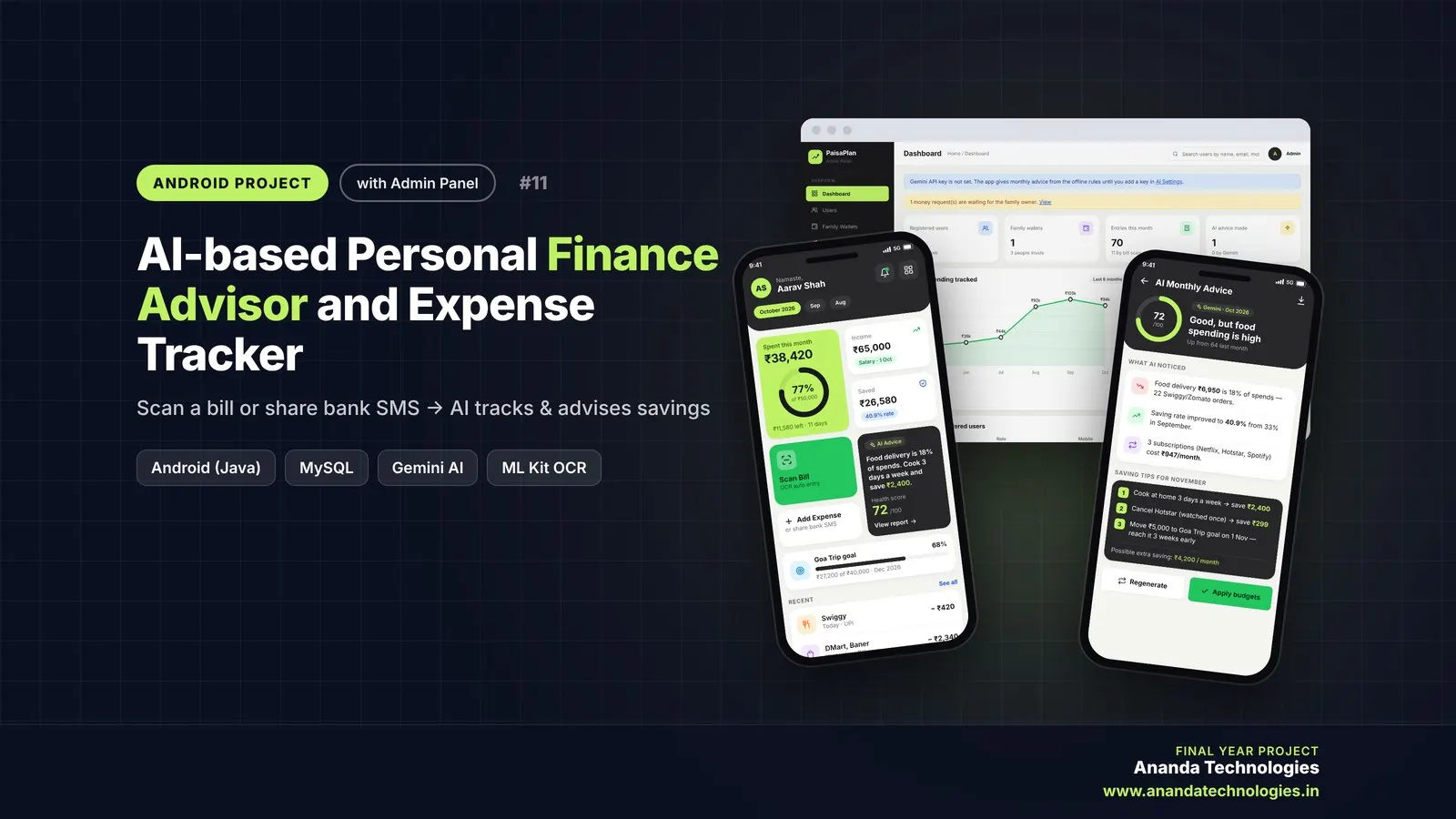
- AI Personal Finance Advisor and Expense Tracker – bill scanning with OCR, SMS-based entries, budgets and AI advice; a good base to add analytics reports.
- Team Task Tracker with Kanban Board – sprints, work-hour logs and an admin panel; easy to explain using Software Project Management concepts.
For more topics, browse our AI and ML projects, Android projects or all BE/BTech projects. Computer Engineering students can also look at our BE/BTech Computer Engineering project ideas for SPPU, since many topics suit both branches.
How to make an IT project stand out in the oral
- Explain the "why" of each technology. Why MySQL and not a NoSQL store? Why an Android app and not only a website? Examiners like short, clear reasons.
- Show data, not only screens. For any AI feature, show accuracy, sample inputs and failure cases.
- Know your architecture diagram. Every member should be able to trace one request from the app to the server and database.
- Split work fairly. If one person built everything, the others struggle in the oral. Give each member a module they can explain.
- Keep the report and the demo the same. Features in the report that are missing in the demo cost marks.
A simple plan for the year
- Start of Semester VII: choose the domain, read 10–15 papers or articles, finalise the topic with your guide.
- Middle of Semester VII: synopsis review, SRS, UML diagrams, first working modules.
- End of Semester VII: Stage I report, presentation and term work.
- First half of Semester VIII: build the remaining modules, test, collect results.
- End of Semester VIII: final report, practice demo, Stage II oral.
Set exact dates from your department notice, because review dates differ between colleges.
Help for Pune IT students
If you want a ready base to learn from and extend, our projects come with source code, database, report and setup guide. Before you pay, you can see the free abstract, screenshots and a report preview on each project page. You can see all options for your city on our final year projects in Pune page.
Frequently asked questions
How many credits does the BE/BTech IT final year project carry in SPPU?
In the SPPU Final Year IT 2019 course, Project Stage I (414448) carries 2 credits and 50 term-work marks in Semester VII, and Project Stage II (414456) carries 5 credits with 100 term-work and 50 oral marks in Semester VIII. Newer NEP batches should check their own syllabus.
What is the group size for an SPPU IT final year project?
The 2019 syllabus guidelines suggest groups of preferably 3 to 4 students. Your department may set its own rule, so confirm with your project coordinator.
Which project topics suit BE/BTech IT students in Pune?
Topics linked to your final-year subjects work well: information retrieval and NLP, deep learning and computer vision, mobile computing, business analytics and software project management. This makes the project easier to explain in the oral.
Can I see a project before I pay for it?
On each project page you can read the free abstract, see screenshots and a report preview before you pay. We do not offer a live demo before payment.