Final Year Projects
SPPU Project Report Format: Stage II Chapters and Checklist
What SPPU asks for in the Project Stage II report, a chapter order most Pune colleges accept, and a checklist to run before you submit and face the oral.
6 min read · updated
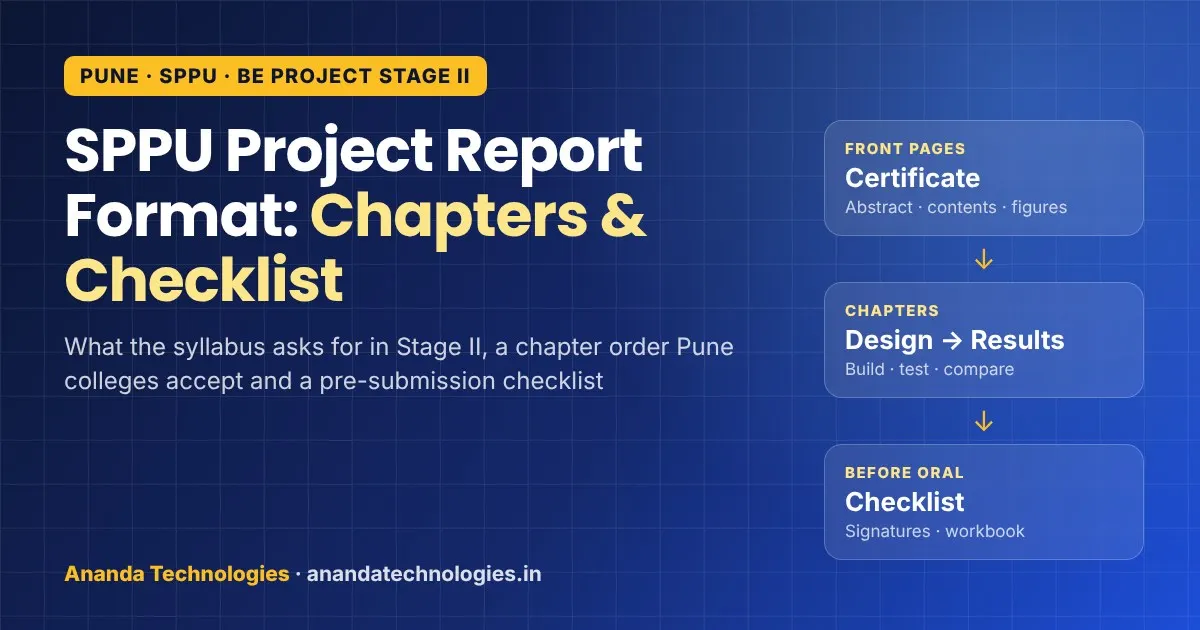
If you are in the final year of BE Computer, IT or AI & DS at an SPPU college in Pune, your Project Stage II report is the document your guide signs, your HOD certifies and your external examiner flips through before the oral. Many students leave it for the last two weeks of March and then fight with formatting, missing diagrams and plagiarism checks. This guide explains what the SPPU syllabus actually asks for, a chapter structure most Pune colleges accept, and a checklist you can run before submission.
One honest note first: SPPU does not publish one fixed font-and-margin template for every college. The university syllabus sets the content and the evaluation; your department gives the exact template (cover page, certificate page, font, spacing). Always follow your department's template where it differs from anything below.
What the SPPU syllabus says about Stage II
For BE Computer Engineering (2019 course), the two project courses are:
| Course | Semester | Credits | Evaluation |
|---|---|---|---|
| 410248 Project Stage I | VII | 2 | Term work 50 |
| 410256 Project Stage II | VIII | 6 | Term work 100 + Oral 50 |
The official guidelines for Stage II say the student completes the remaining work: selection of technology and tools, installations, UML implementation, testing, results and performance discussion, using data tables for the parameters you improved, with comparative analysis against existing systems and validation of results and conclusions. The report must be prepared "in standard format" and certified by the guide and the head of department. Students are also told to follow the Project Workbook recommended by the Board of Studies.
IT and AI & DS branches follow the same two-stage pattern with their own course codes, so check your branch syllabus for the exact code and marks. If you need a refresher on how Stage I and Stage II fit together, read our SPPU final year project guide.
The Project Workbook matters as much as the report
The SPPU project workbook (the log book your guide signs) is not optional paperwork. Colleges use it to record progress reviews during the year, and workbooks used in SPPU colleges ask you to bring it to every review, presentation and exam, and submit it after the final exam. Some colleges also ask for the report to be prepared in LaTeX, so ask your coordinator early.
Practical tip: keep the workbook updated after every review. Examiners notice when ten signatures have the same date and the same pen.
A chapter structure that works for most Pune colleges
Your college template wins, but this order matches what the syllabus asks for and is common across SPPU departments:
Front pages
- Cover page (title, names, exam seat numbers, guide, department, college, academic year)
- Certificate signed by guide, HOD and principal
- Sponsorship certificate (only if the project is industry sponsored)
- Acknowledgement
- Abstract (one page, 200–300 words)
- Table of contents, list of figures, list of tables, abbreviations
Main chapters
- Introduction – background, motivation, problem statement, objectives, scope
- Literature survey – papers and existing systems you studied in Stage I, with a short gap analysis
- Software requirements specification – functional and non-functional requirements, hardware and software requirements, users
- System design – architecture diagram, DFD, UML diagrams (use case, class, sequence, activity), database design
- Project plan – timeline, task division among members, risk notes
- Implementation – technology and tools chosen and why, installation and setup, module-wise explanation, important algorithms
- Testing – test plan, test cases in a table (input, expected result, actual result, pass/fail)
- Results and discussion – screenshots, output tables, comparison with an existing system or method, performance parameters
- Conclusion and future scope
- References – in one consistent style (IEEE style is common)
Annexures
Plagiarism report, paper publication or conference certificate (if any), and anything else your department lists.
Notice that chapters 6 to 8 are exactly what the Stage II guidelines name: tools, installation, implementation, testing, results, comparison and validation. A report that has a beautiful literature survey but only two pages of results will feel weak in the oral.
Stage II report checklist before you print
Run through this list a week before submission, not the night before.
Content
- Problem statement and objectives match what you presented in Stage I (or you explain the change)
- Every module promised in the SRS is implemented, or the report says honestly why not
- At least one comparison table: your system vs an existing app, algorithm or manual process
- Test cases with expected and actual results, not just "tested successfully"
- Screenshots are readable and each has a figure number and caption
Diagrams
- Architecture, DFD and UML diagrams match the code you actually wrote
- Database tables in the report match your real schema
- Diagram text is legible when printed
Format
- Department template followed for cover, certificate, font and spacing
- Page numbers, figure numbers and table numbers are continuous and listed in the contents
- References are cited in the text, not just listed at the end
- Spelling and grammar checked; no copied paragraphs (run the plagiarism check your college uses)
Paperwork
- Guide and HOD signatures on the certificate
- Workbook complete and signed for every review
- Soft copy (PDF + source code) ready for the department, and a copy kept by each member
How the report connects to your oral
The 50 oral marks are decided by the internal and external examiners after your demo and questions. Examiners usually open the report at the design or results chapter and ask you to explain it, so every group member should be able to explain:
- why you chose this technology stack
- one diagram end to end (for example the sequence diagram of login or payment)
- one test case that failed during development and how you fixed it
- what you would add in future scope
If your project uses AI or ML, expect questions on the dataset, model accuracy and why you picked that model.
Projects that make a clean Stage II report
A good report is easier when the project has clear modules, a real database and measurable results. Some examples from our catalogue that suit SPPU Computer and IT students:
- Face recognition based smart attendance system – accuracy and timing results fit well in a results chapter
- Plant leaf disease detection using deep learning – a natural comparison table of model performance
- AI based question paper generator for teachers – clear admin, teacher and output modules
- College bus live tracking with ETA – good for sequence diagrams and real-time testing
- AI based mental wellness companion and mood tracker – user-centred testing and screenshots
- Notes and question paper portal (PHP) – a simple web stack with a clear database design
For each project you can check the free abstract, screenshots and a report preview before deciding. You can browse more on the BE/BTech projects page.
Help for Pune students
If you study at an SPPU college in Pune, Pimpri-Chinchwad or nearby, our final year projects in Pune page lists projects, report support and how we work with students there. Still choosing a topic? Read how to choose a final year project first. Whatever you build, write the report yourself in your own words and understand every chapter: that is what the oral really tests.
Frequently asked questions
Does SPPU give one fixed project report format for all colleges?
SPPU sets the content and evaluation of Project Stage II in the syllabus and asks for the report in a standard format certified by the guide and HOD. The exact cover page, font, spacing and binding come from your department, so always follow your college template.
How many marks does Project Stage II carry in SPPU BE Computer Engineering?
In the 2019 course, Project Stage II (410256) in semester VIII has 6 credits with 100 marks of term work and 50 marks of oral. Project Stage I (410248) in semester VII has 2 credits and 50 marks of term work. Other branches have their own codes, so check your branch syllabus.
Which chapters are most important in the Stage II report?
Implementation, testing and results. The SPPU guidelines specifically mention selection of tools, installation, UML implementation, testing, results with data tables, comparison with existing systems and validation of conclusions, so these chapters should be detailed and match your actual code.
Do I need the project workbook for the final oral?
Yes. SPPU colleges use the project workbook recommended by the Board of Studies to record progress reviews, and students are usually asked to bring it to every review and the final examination. Keep it updated and signed after each review.