Final Year Projects
How to Choose a Final Year Project: A Step-by-Step Guide
A simple 7-step way to choose a final year project you can actually build, explain in the viva and finish before the deadline.
Choosing the final year project is one of the first big decisions of your last year. Pick a topic that is too hard and you spend months stuck. Pick one that is too simple and the examiner asks why you chose it. This guide walks you through a simple way to choose well.
1. Start with your branch and your syllabus
Your project should match what you studied. A computer engineering student can build a web or Android app; an IT student can go for a data or cloud project; a diploma student following the MSBTE scheme should check what the capstone project rules ask for. Read your college guidelines first: group size, report format, and the dates for the synopsis, the review and the final submission.
2. Pick a technology you can explain
In the viva you will be asked how your project works. Choose a language you have already used in practicals, or one you are ready to learn properly in the next few weeks.
Python
Data, automation and AI/ML ideas. Python projects
PHP with MySQL
Web portals and management systems. PHP projects
Java
Desktop and enterprise-style applications. Java projects
Android
When the idea is naturally a mobile app. Android projects
3. Solve a real problem
Examiners like projects that solve a problem someone actually has. Look around you: your college, a local shop, a clinic, a farmer, a hostel. "Online attendance for our college with QR codes" is easier to defend than a vague "student management system".
4. Check the size against your time
Count the months until submission and divide the work: requirement study, design, coding, testing and the report. A good project has 4–6 clear modules (for example: login, admin panel, main feature, reports, notifications). If you cannot list the modules on one page, the scope is too big.
5. Make sure you get a report and can run it on any machine
Your submission is not only code. You need a project report (abstract, introduction, system design, diagrams, testing, conclusion), and the project must run on the college computer during the demo. Before you finalise the topic, check that you can install everything it needs on a normal laptop.
6. Talk to your guide early
Show your guide two or three ideas, not one. Ask which one fits the department's expectations. A five-minute talk at the start can save weeks of rework later.
7. Plan the viva from day one
While you build, keep notes on why you made each choice: why this database, why this algorithm, what you would improve. These notes become your viva answers.
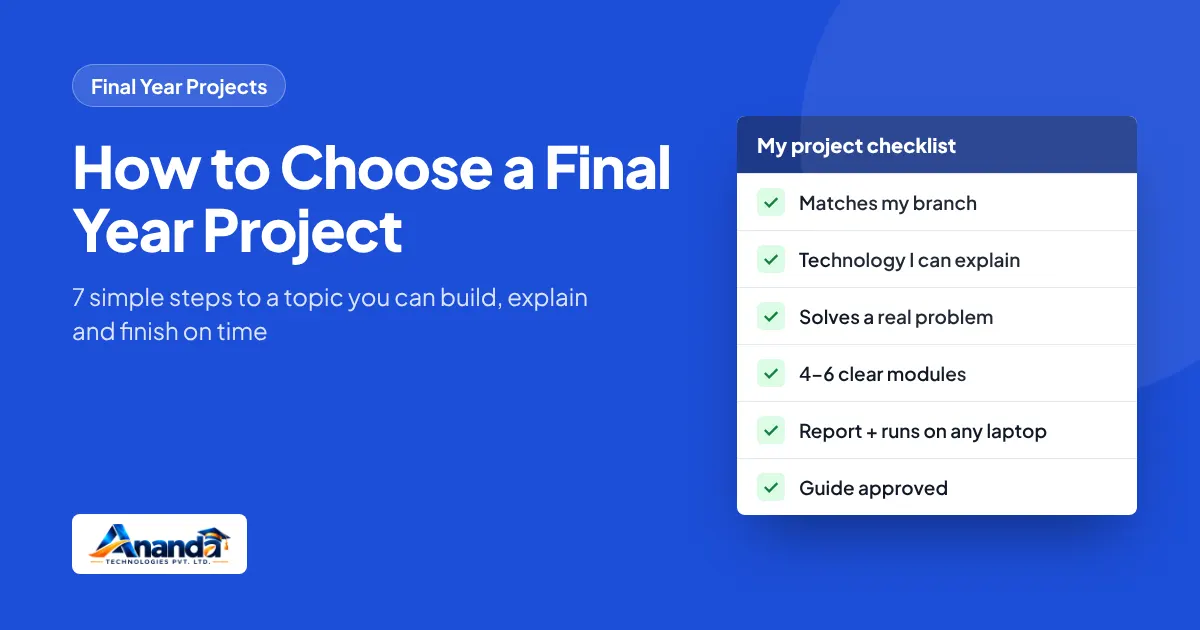
Quick checklist
- The topic matches my branch and college guidelines
- I can explain the technology in my own words
- It solves a real, specific problem
- It has 4–6 clear modules I can finish in time
- I will have a report and it runs on a normal laptop
- My guide has approved it
Need a ready starting point? Browse final year projects with source code or, for diploma students, the MSBTE capstone projects page. Every project comes with documentation and setup help, and you can ask us questions before you choose.
Frequently asked questions
When should I choose my final year project?
As early as possible in the final year, ideally before your college asks for the synopsis. Starting early gives you time to learn the technology and to fix problems before the reviews.
Which language is best for a final year project?
The one you can explain confidently. Python suits data and AI/ML ideas, PHP with MySQL suits web portals, Java suits desktop applications and Android suits mobile apps.
Can I use a ready project with source code?
You can use it as a starting point and learning material, but you must understand every part of it and follow your college rules. In the viva you will be asked how it works.