Final Year Projects
SPPU Project Stage I Guide: Literature Survey, SRS and Design Explained
What SPPU's Project Stage I (410248) actually asks for in Semester VII, how to write the problem statement, literature survey, SRS and design, and a week-by-week plan for Pune BE students.
6 min read · updated
Project Stage I is the semester where most SPPU final year groups either set up an easy Semester VIII or create problems they carry till the oral exam. If you are a BE Computer, IT or AI & DS student in a Pune college, this guide explains what the university actually asks for in Stage I, what each part means in plain words, and how to plan the semester so your design is ready before the exam panel sits.
Everything below is based on the SPPU Fourth Year Computer Engineering (2019 Course) syllabus, which current BE batches follow. Other branches and newer patterns may use different course codes, so always check your own syllabus and your department's Project Workbook.
What SPPU says about Project Stage I
In the 2019 course, Project Stage I is course 410248 in Semester VII. The course structure gives it:
| Item | Project Stage I (410248) | Project Stage II (410256) |
|---|---|---|
| Semester | VII | VIII |
| Teaching scheme | 2 hrs/week practical | 6 hrs/week practical |
| Credits | 2 | 6 |
| Exam scheme | Term work 50 | Term work 100 + Oral 50 |
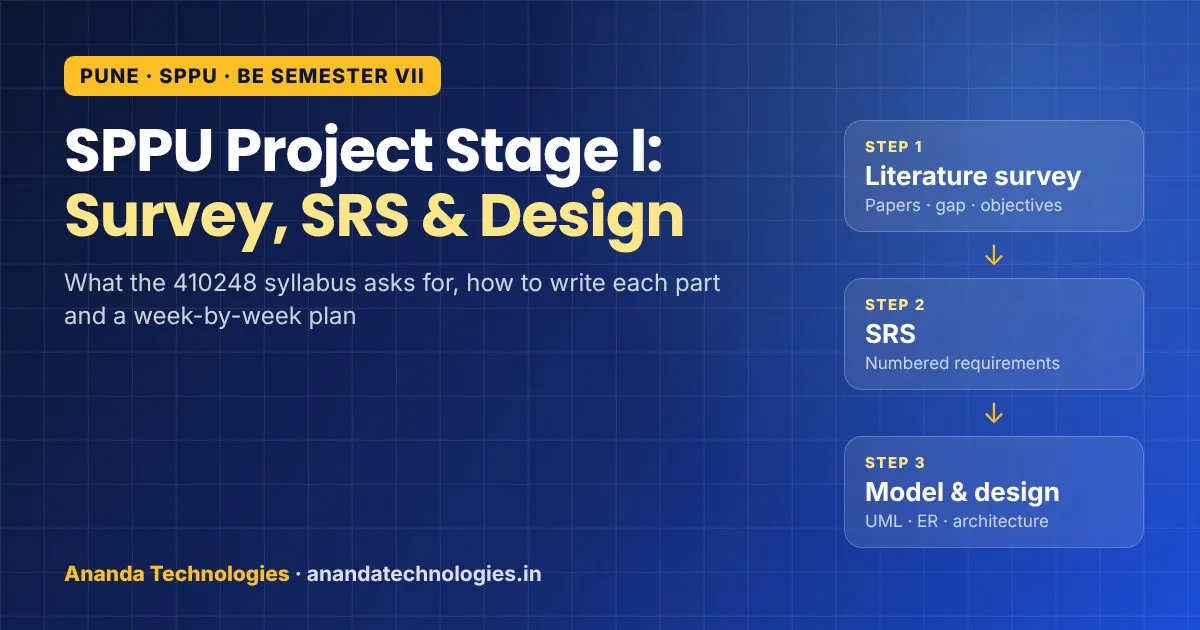
The official guidelines say Stage I is the partial work of the project and should consist of the problem statement, literature review, SRS, model and design. The group is expected to complete the project at least up to the design phase. Three more points from the syllabus matter for your marks:
- You deliver a presentation on the advancement in technology related to your topic, as part of the progress report.
- You submit a progress report in standard format, certified by your guide and the Head of Department.
- You are assessed by a panel that includes an external examiner, broadly on work done, content delivery, presentation skills, documentation, question-answers and the report.
The syllabus also tells you to follow the formats in the Project Workbook recommended by the Board of Studies. Your college gives you this workbook; keep it updated after every guide meeting.
Part 1: Problem statement
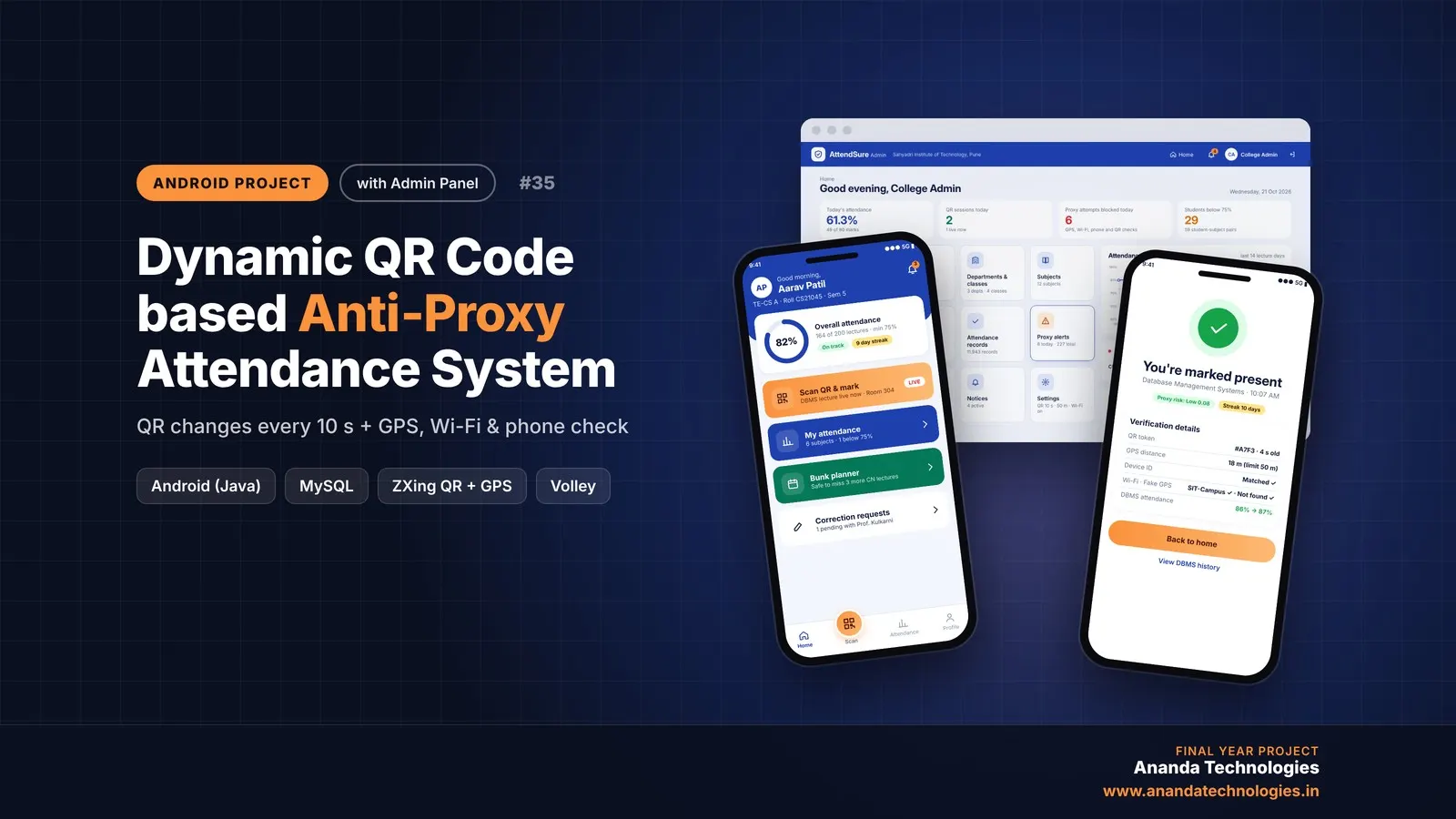
A good problem statement is short, specific and testable. "Smart attendance system" is a title, not a problem. A better version: "Manual roll call wastes lecture time and proxies go unnoticed; build an Android app that marks attendance with a rotating QR code and blocks shared screenshots."
Write it in three parts:
- Who has the problem (students, farmers, hospital staff, citizens).
- What goes wrong today and why the current method fails.
- What your system will do, with 3–5 clear objectives.
Keep the scope small enough for a 3–4 member group to build in one semester. Examiners commonly ask "what exactly is new here?", so note your one or two key features early.
Part 2: Literature survey
The literature survey shows that you know what already exists. Most guides expect you to read recent papers from IEEE, Springer, Elsevier or reputed Indian journals, plus existing apps and products in the same area. Your department may set a minimum number of papers, so ask your guide.
For each paper, record:
- Title, authors, year and where it was published
- Method or algorithm used
- Dataset or test setup
- Result reported
- Limitation or gap
Put this in a comparison table in your report. Then end the chapter with a short research gap paragraph that leads directly to your objectives. This link between gap and objective is what turns a list of papers into a real survey.
Do not copy abstracts. Write each summary in your own words and cite every source. Many colleges run a plagiarism check on the report.
Part 3: SRS (Software Requirements Specification)
The SRS describes what the system must do before you write code. Many colleges use an IEEE-style structure. A practical SRS for a final year software project includes:
- Purpose and scope of the system
- User classes: for example student, teacher, admin
- Functional requirements: numbered, one action each ("FR-3: The admin can approve a new teacher account")
- Non-functional requirements: performance, security, usability, availability
- Hardware and software requirements: Android version, PHP/MySQL version, Python libraries, cloud API
- Assumptions and constraints
Number your requirements. In Stage II, your test cases will map back to these numbers, which makes the testing chapter much easier.
Part 4: Model and design
This is where most groups lose time. The syllabus says "model and design", and the Project Workbook lists items such as a mathematical model, UML diagrams, ER diagram, block diagram and a project plan. Check your workbook for what your department expects. For a typical software project, prepare:
- System architecture / block diagram showing app, server, database and any ML model or API
- Mathematical model (some SPPU Computer departments ask for a set-theory model: input, output, functions, success and failure conditions)
- UML diagrams: use case, class, sequence, activity, and component or deployment diagrams
- ER diagram and table design if you use a database
- Algorithm or ML pipeline if your project uses AI: dataset, preprocessing, model, evaluation metric
- Project plan: a timeline or Gantt chart for Semester VIII
If your diagrams are clean and your requirements are numbered, Stage II becomes "build what we already designed".
Part 5: Technology presentation and progress report
Besides your project slides, the syllabus asks for a presentation on advancements in technology linked to your topic. If you are doing a sign language recognition app, for example, you can talk about how on-device ML frameworks have changed what a phone can detect in real time. Keep it factual and cite sources.
The progress report usually follows the same chapter order as the final report: introduction, literature survey, problem statement and objectives, SRS, system design, project plan, conclusion and references. For format details, see our SPPU project report format guide.
A simple Semester VII plan
Your department fixes the review dates, so adjust this to your calendar:
| Weeks | Work |
|---|---|
| 1–2 | Form group, shortlist 3 topics, meet guide, submit synopsis |
| 3–5 | Read papers, build comparison table, finalise problem statement |
| 6–8 | Write SRS, draw architecture and UML, prepare ER diagram |
| 9–10 | Mathematical model, algorithm design, small proof-of-concept if possible |
| 11–12 | Progress report, technology presentation, mock review with guide |
A small working prototype of the core feature (for example, the ML model giving one correct prediction) is not compulsory in Stage I, but it gives you confidence in the viva and shows the design is realistic.
Topic ideas that fit Stage I well
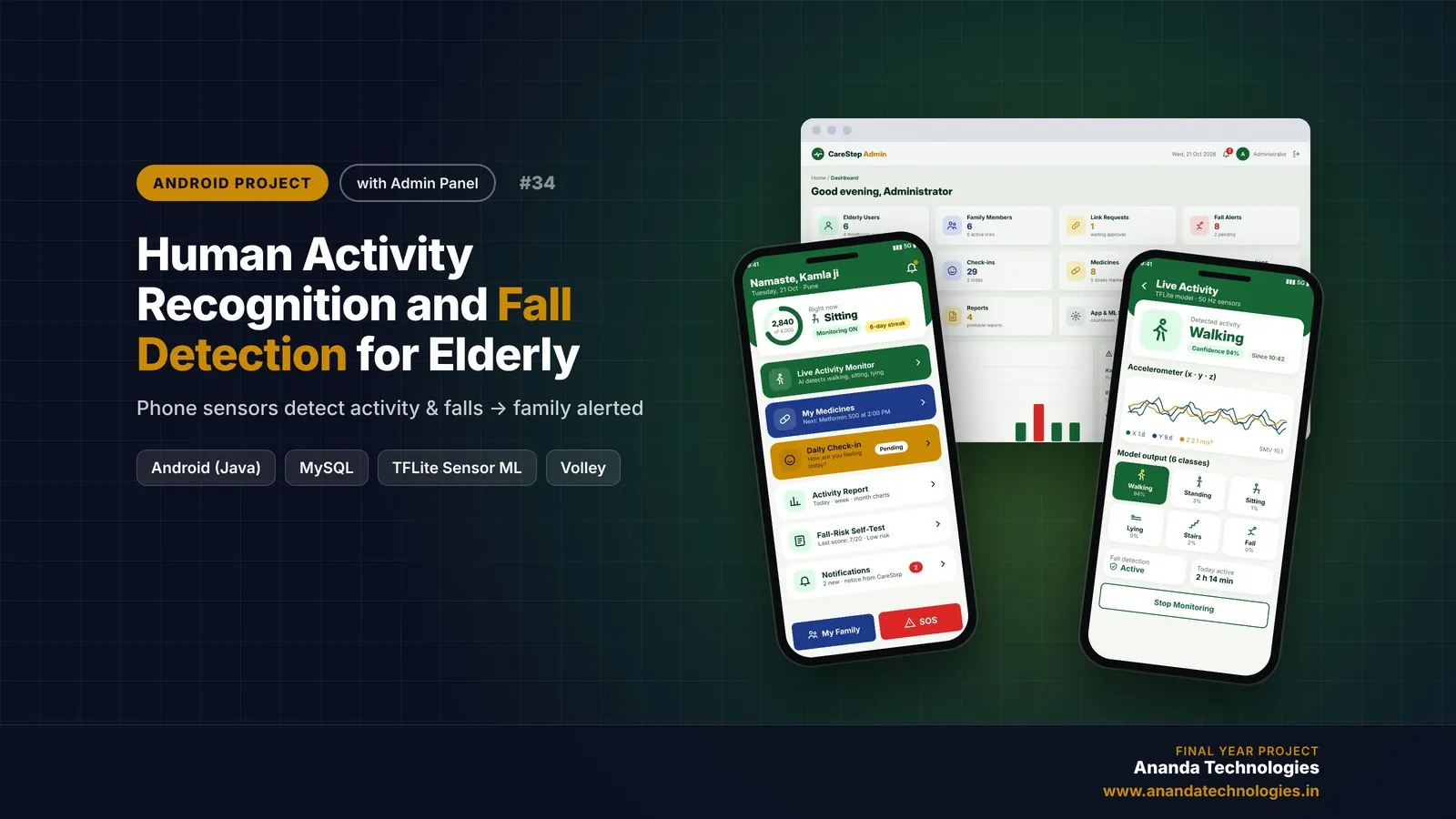
AI-based software topics have plenty of recent papers for the literature survey and clear objectives for the SRS. A few examples from our catalogue that suit BE Computer and IT groups:
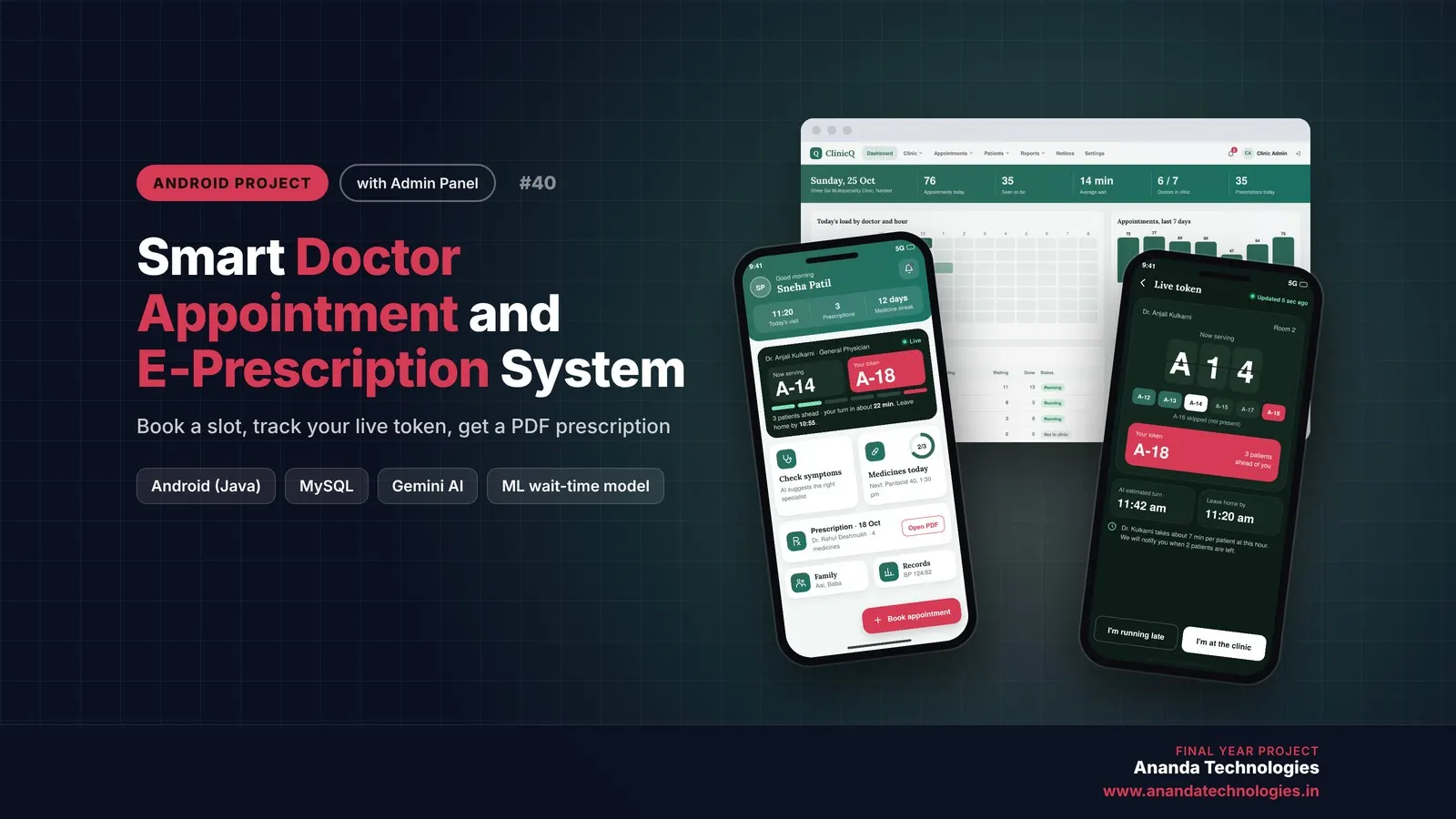
- Driver drowsiness detection and alert system: eye and yawn detection on Android
- Indian sign language to text and speech converter: live gesture recognition
- AI-based answer sheet evaluation system: OCR plus AI marking with teacher review
- Student performance prediction and early warning app: on-device ML for at-risk students
- AI civic complaint classification system: photo classification and auto routing
- Assignment submission app with similarity check: TF-IDF based copy detection
You can browse more BE/BTech projects and AI and ML projects. Each listing has a free abstract, screenshots and a report preview so you can check the scope before your synopsis. Still deciding? Read how to choose a final year project.
For Pune students
If you study in an SPPU college in Pune, Pimpri-Chinchwad or nearby, our final year projects in Pune page lists projects and support for your semester. For the full two-semester picture, read the SPPU final year project guide.
Frequently asked questions
How many marks is SPPU Project Stage I?
In the BE Computer Engineering 2019 course, Project Stage I (410248) carries 2 credits and 50 term work marks, with 2 hours per week of practical. Other branches or newer patterns may differ, so check your own syllabus.
What must be completed in Project Stage I?
The SPPU guidelines say Stage I covers the problem statement, literature review, SRS, model and design. The group should finish at least the design phase, give a presentation on technology advancements in the topic and submit a certified progress report.
Do we need working code in Project Stage I?
The syllabus expects work up to the design phase, so full code is not required. A small proof-of-concept of the core feature can still help you answer examiner questions with confidence.
Who evaluates Project Stage I?
A panel of examiners that includes at least one external examiner. Assessment is broadly based on work done, content delivery, presentation skills, documentation, question-answers and the report.