Final Year Projects
BE/BTech Computer Engineering Project Ideas for SPPU Colleges in Pune
Software-only BE/BTech computer engineering project ideas for SPPU students in Pune, mapped to your Semester VII and VIII subjects like Machine Learning, Deep Learning and NLP, with a 5-point check for your topic.
6 min read · updated
Looking for BE/BTech computer engineering project ideas Pune colleges will approve without a fight? If you are in BE/BTech Computer Engineering at an SPPU college in Pune, Pimpri-Chinchwad or nearby, your final year project runs across both semesters: Project Stage I (410248) in Semester VII and Project Stage II (410256) in Semester VIII. The hardest part for most groups is not coding. It is picking a topic that is fresh, matches the syllabus, and can actually be finished before the Stage II oral.
This post gives you BE/BTech computer engineering project ideas for Pune students, mapped to the subjects you already study in final year, plus a simple way to check if an idea is strong enough for your guide.
How the BE/BTech project is set up in SPPU (2019 course)
The current BE/BTech Computer Engineering structure (2019 course, final year from 2022-23) looks like this for the project:
| Course | Semester | Teaching | Credits | Evaluation |
|---|---|---|---|---|
| 410248 Project Stage I | VII | 2 hrs/week practical | 2 | Term Work 50 |
| 410256 Project Stage II | VIII | 6 hrs/week practical | 6 | Term Work 100 + Oral 50 |
Stage II carries three times the credits of Stage I, so your topic must have enough real work in it for a full semester of building and testing. Rules for group size, review dates and the report template are set by your department, so always check your college's notice and your syllabus copy.
For a stage-by-stage plan, read our SPPU final year project guide and the detailed SPPU Project Stage I guide.
Start from your own final year subjects
A smart trick: choose a project that uses a subject you are studying anyway. Your Semester VII and VIII theory then helps your project, and your guide can see the link clearly. In the 2019 course, final year Computer Engineering includes:
- Semester VII: Design and Analysis of Algorithms, Machine Learning, Blockchain Technology, plus Elective III and IV (options include Cyber Security and Digital Forensics, Mobile Computing, Information Retrieval, Software Testing and Quality Assurance, and more).
- Semester VIII: High Performance Computing, Deep Learning, plus Elective V and VI (options include Natural Language Processing, Image Processing, Pattern Recognition, Soft Computing and Business Intelligence).
Electives differ from college to college, so match your idea to the ones your batch has actually chosen.
BE/BTech computer engineering project ideas mapped to SPPU subjects
These are software-only ideas (Android, web, AI/ML). No hardware kits are needed, so your group does not lose weeks waiting for sensors or boards.
| Project idea | Main subject link | Typical stack |
|---|---|---|
| Vision assistant for visually impaired users | Deep Learning, Image Processing | Android, TensorFlow Lite, text-to-speech |
| Skin disease detection from photos | Deep Learning (CNN) | Android, TFLite, PHP/MySQL admin |
| Fall detection with activity recognition | Machine Learning, Pattern Recognition | Android phone sensors, TFLite |
| Road accident detection and alert | Machine Learning, Mobile Computing | Android sensors, GPS, ML model |
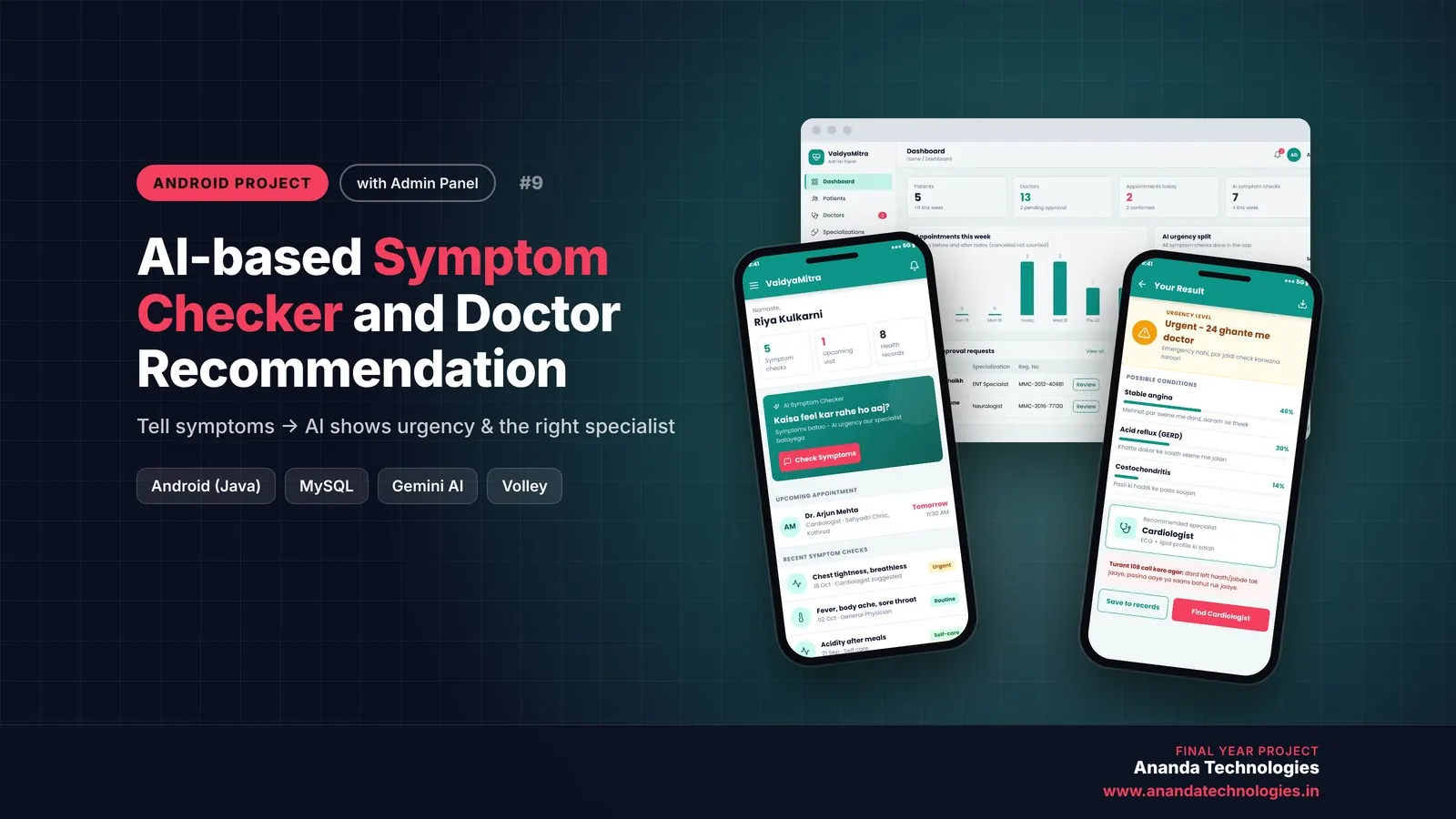
| AI symptom checker with doctor booking | NLP, Machine Learning | Android, Gemini API, MySQL |
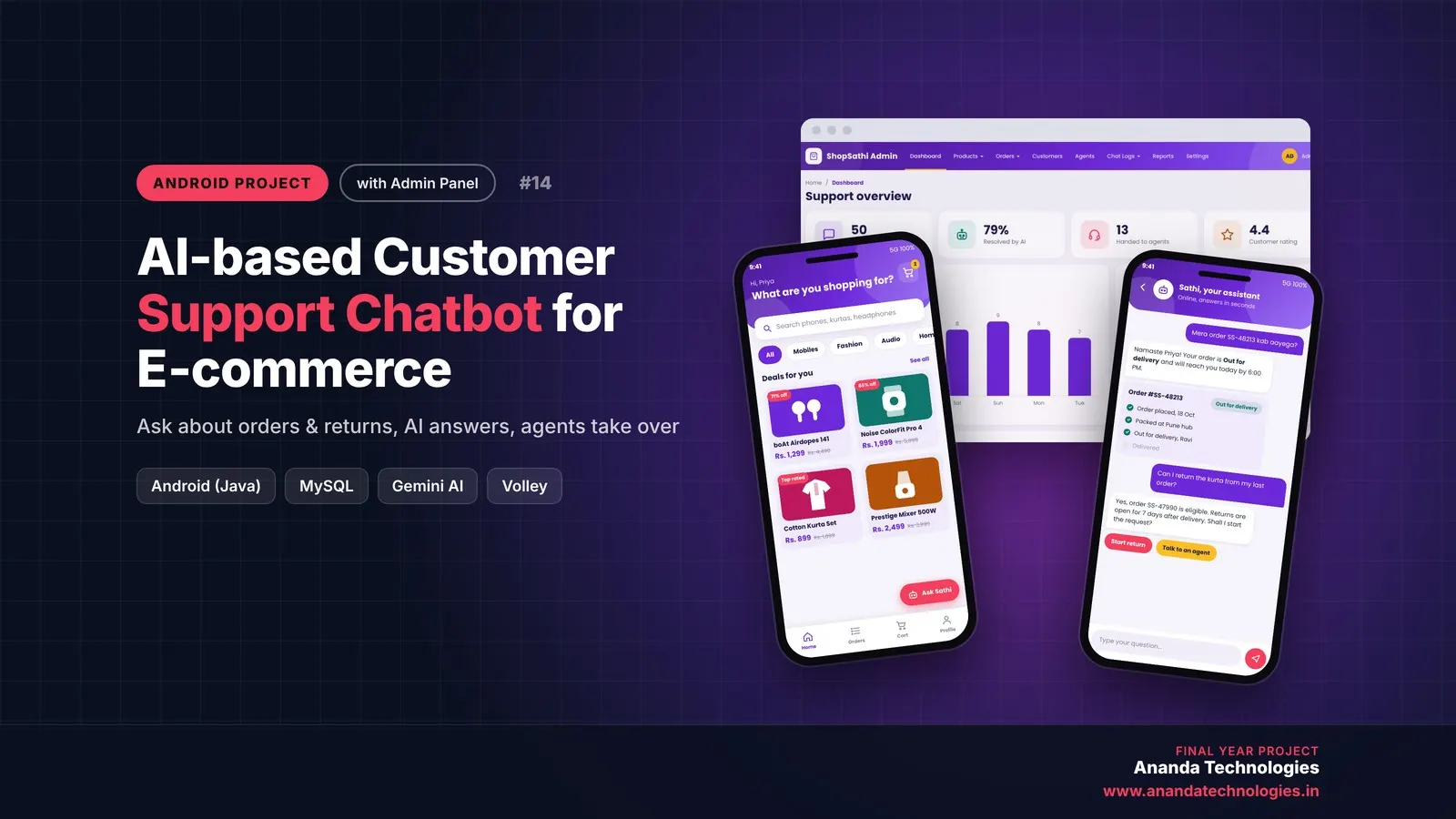
| E-commerce customer support chatbot | NLP, Information Retrieval | Android, PHP, MySQL, Gemini |
| Smart waste classification | Deep Learning, Image Processing | Android, TFLite CNN |
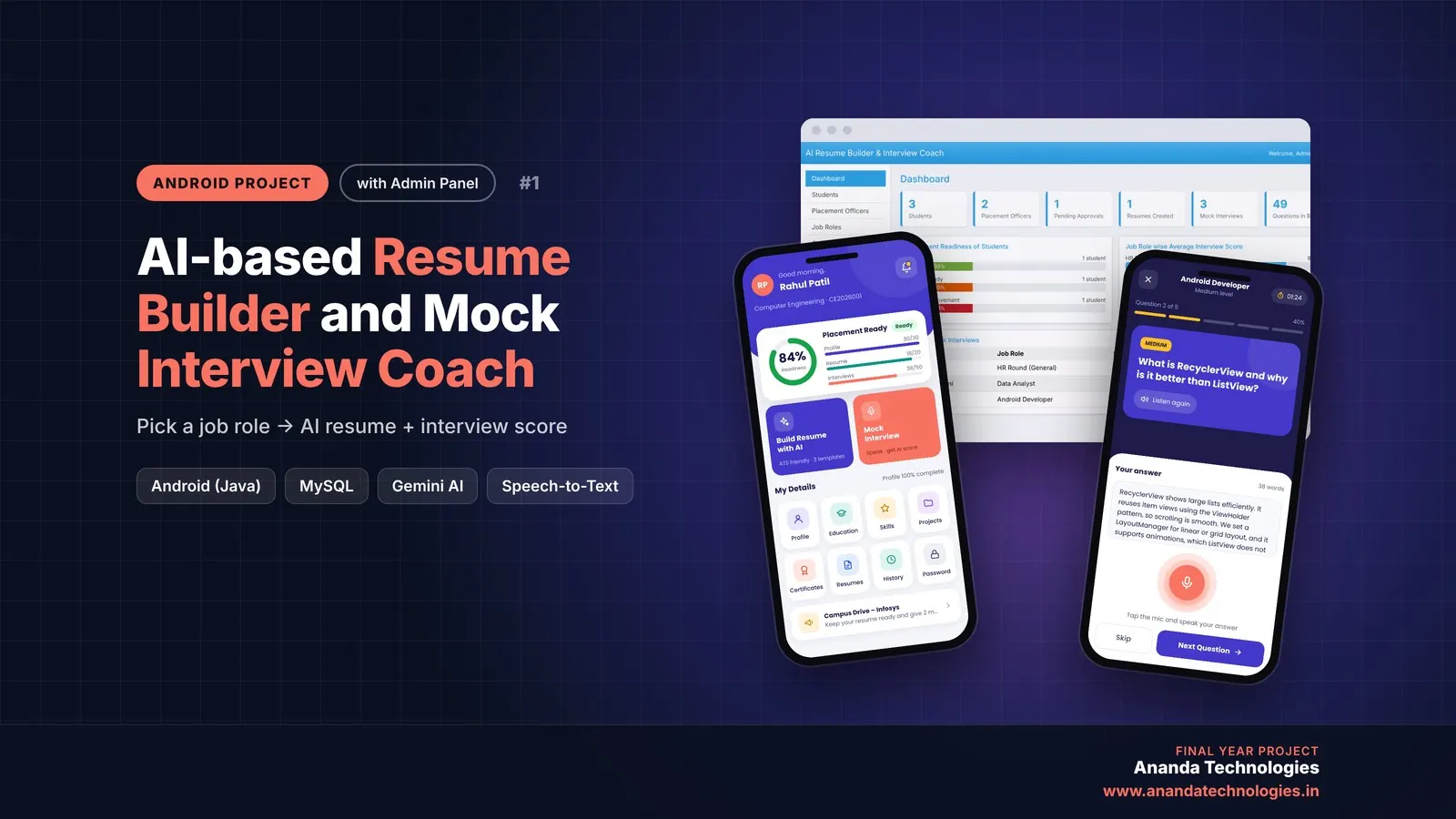
| Resume builder with mock interview coach | NLP | Android, Gemini API, speech input |
AI and deep learning ideas
Image-based projects are a natural fit for Deep Learning and Image Processing. An AI vision assistant for visually impaired users reads text, scenes and currency aloud. A skin disease detection app using CNN runs a TFLite model on the phone. A smart waste classification app tells users which bin a waste item belongs in. Each of these lets you show a dataset, a trained model, accuracy results and a working app, which is exactly what examiners like to see in the results chapter.
Machine learning with phone sensors
If your group prefers Machine Learning over images, use the sensors already inside an Android phone. A fall detection app for elderly people classifies activities from accelerometer data and alerts family. A road accident detection and emergency alert app detects a crash and sends the location. Both give you a clear problem statement and measurable results without any extra hardware.
NLP and generative AI ideas
For students who chose Natural Language Processing, chat-style projects work well. An AI symptom checker with doctor recommendation does triage and booking. An AI customer support chatbot for e-commerce answers order questions with a PHP and MySQL backend. An AI resume builder and mock interview coach is useful for your own placement season too. If you use an AI API, explain clearly in the report what the API does and what your group built around it (database, admin panel, prompts, testing), because examiners will ask.
Blockchain and security angles
Blockchain Technology is a core subject in Semester VII, and Cyber Security is a common elective. You can add a security layer to almost any idea above: tamper-proof logs, hashed records, role-based access or audit trails. Keep it realistic. A small, working feature that you can explain in the oral is better than a big claim you cannot demonstrate.
How to check if your idea is strong enough
Before you submit the topic in Stage I, ask these five questions as a group:
- Is there a real user? Name who will use it: patients, elderly people, shop owners, students.
- Is there a clear "smart" part? A model, an algorithm or an AI step that a plain CRUD app does not have.
- Can you measure results? Accuracy, response time, or a comparison with an existing method for the results chapter.
- Can 3 to 4 people split the work? App, backend, model and testing/report make a natural split.
- Can it be finished by the Stage II oral? Avoid hardware delays and topics that need data you cannot get.
If an idea passes all five, it is usually safe to take to your guide. Then prepare your literature survey, SRS and design for Stage I, and plan the build, testing and project report in the SPPU format for Stage II.
Mistakes Pune students often make
- Copying a trending title without understanding it. Examiners ask "why this algorithm?" in the oral. Know your model, dataset and limits.
- Choosing a topic that is too big. "AI for healthcare" is a field, not a project. "Skin disease detection from phone photos" is a project.
- Ignoring the admin side. Most real systems need an admin panel, reports and user management. It also gives every group member a clear module.
- Leaving testing for the last week. Stage II needs test cases and results. Start testing as soon as the first module works.
Need a ready base for your project?
Ananda Technologies has ready Android and PHP/MySQL final year projects for BE/BTech students, many with AI and TensorFlow Lite features. Before you decide, you can see the free abstract, screenshots and a report preview on each project page. Browse the BE/BTech projects and AI/ML projects, or visit our page for final year projects in Pune to see what students in Pune colleges usually pick.
Frequently asked questions
Which subjects should a BE/BTech Computer Engineering project in SPPU be based on?
There is no fixed rule, but linking your project to final year subjects like Machine Learning, Deep Learning, Blockchain Technology or your electives (NLP, Image Processing, Mobile Computing) makes it easier to justify in Stage I and to explain in the Stage II oral.
How many marks are the SPPU BE/BTech project stages worth?
In the 2019 course, Project Stage I (410248) has 50 term work marks and 2 credits, and Project Stage II (410256) has 100 term work plus 50 oral marks and 6 credits. Always confirm with your current syllabus and department notice.
Can we do a software-only project instead of a hardware project in BE/BTech Computer?
Yes. Android, web and AI/ML projects are fully accepted for Computer Engineering. Phone sensors, cameras and cloud AI APIs give you smart features without buying any hardware kit.
Can I see a ready project before I pay for it?
On Ananda Technologies you can check the free abstract, screenshots and a report preview on each project page before you decide. We do not offer a live demo before payment.