Final Year Projects
Black Book Format for Mumbai University BE/BTech Final Year Project
Chapter-by-chapter black book format for Mumbai University BE/BTech Major Project 2: what the official syllabus asks for, what to submit and common mistakes.
6 min read · updated
If you are in BE/BTech final year and searching for the black book format Mumbai University expects, this guide walks you through what the official syllabus actually asks for, how to arrange the chapters, and the small things that cost groups marks at the final oral. Everything below is based on the University of Mumbai Computer Engineering syllabus (Rev 2019 'C' scheme, with effect from 2022-23). Other branches such as IT, AI & DS and CSE (AI & ML) follow a very similar Major Project structure, but always confirm the details with your own department.
What the "black book" is in Mumbai University engineering
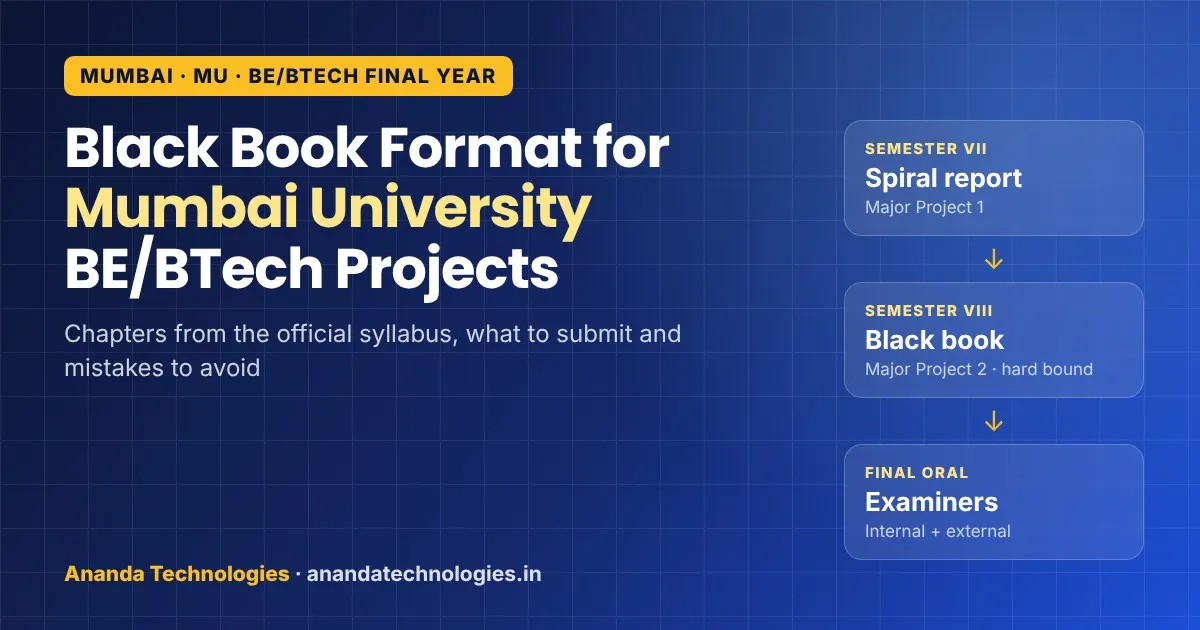
In MU engineering colleges, "black book" is the common name for the final hard-bound Major Project report you submit in Semester VIII. The official syllabus for Major Project 2 lists "Project Report (Black Book) (both side print)" as one of the items used to award term work marks. In Semester VII, the Major Project 1 report is a spiral-bound report (also printed on both sides), so the black book is the complete, final version of the same work.
Here is how the two stages compare in the Computer Engineering scheme:
| Item | Major Project 1 (Sem VII) | Major Project 2 (Sem VIII) |
|---|---|---|
| Course code (Computer Engg) | CSP701 | CSP801 |
| Credits | 3 | 6 |
| Term work | 50 marks | 100 marks |
| Oral & practical | 25 marks | 50 marks |
| Report type | Spiral bound, both side print | Black book (hard bound), both side print |
| Group size | 2 to 4 students | 2 to 4 students |
Course codes differ for other branches, so check your branch syllabus for the exact code and marks.
Chapters the MU syllabus asks for
The syllabus says each group must prepare the report "as per the guidelines issued by the University of Mumbai" and that it should preferably contain at least the following sections. A clean way to turn that list into chapters:
- Abstract – one page: the problem, your approach and the main result.
- Introduction – background, motivation and an overview of the system.
- Literature Survey / Existing System – summarise papers and existing apps. The Sem VII guidelines recommend papers from IEEE, Elsevier, ACM etc. that are not more than 3 years old.
- Limitations of the Existing System or Research Gap – what the current solutions miss.
- Problem Statement and Objectives – short, measurable objectives.
- Proposed System – with sub-sections for Analysis / Framework / Algorithm, Design Details (architecture, UML, DFD, ER diagram) and Methodology.
- Experimental Setup – details of the database or input data, performance evaluation parameters used for validation, and the software and hardware setup.
- Results and Discussion – screenshots, test cases, tables and graphs, compared against your objectives.
- Conclusion and Future Work.
- References.
- Appendix – list of publications or certificates (for example, a paper or project competition certificate).
Before Chapter 1 you will normally add the front pages your department asks for: title page, certificate signed by the guide and HOD, approval sheet for examiners, declaration, acknowledgement, and the lists of contents, figures and tables. MU does not publish one single font and margin template for every college, so use the template your department gives you.
What changes from the Sem VII report
The Sem VII report ends with an Implementation Plan for Next Semester, including a timeline chart for Term I and Term II. In the black book, that plan is replaced by actual Results and Discussion, Conclusion and Future Work, and the appendix. Reuse your Sem VII chapters, but update the literature survey and design if the project changed during the year.
What you submit along with the black book
For Major Project 2, the syllabus says the report should be submitted in hard copy, and each group should also submit a soft copy of the report along with project documentation, implementation code, required utilities, software and user manuals. Keep these ready in one folder:
- Final report PDF (same as the printed black book)
- Source code and database file
- Setup or installation steps and a short user manual
- Presentation slides for the term-end presentation
How the black book affects your marks
Term work for Major Project 2 is distributed across four items listed in the syllabus:
- Weekly log report
- Completeness of the project and project work contribution
- Project Report (Black Book)
- Term-end presentation (internal)
The oral and practical (final project evaluation) is conducted by internal and external examiners approved by the University. The suggested quality parameters include relevance to the specialisation or industry trends, modern tools used, innovation, quality and completeness of the work, validation of results, impact and business value, quality of written and oral presentation, and individual as well as team work.
Notice that "validation of results" and "quality of written presentation" both depend heavily on your report. A black book with clear results tables and evaluation parameters is easier for the examiner to mark well.
Common black book mistakes
- Copy-pasted literature survey with no comparison table. Add a table: paper, method, dataset or tools, limitation.
- Results chapter with only screenshots. Add test cases, accuracy or response-time figures (whatever fits your project) and compare them with your objectives.
- Diagrams that do not match the code – for example an ER diagram with tables your database does not have.
- No weekly log – the log report is a separate term work item, so keep it updated every week, not at the end.
- Printing too early. Get the guide's corrections first; reprinting a hard-bound book is costly and slow near submission.
- Missing appendix. If you published a paper or took part in a competition (the syllabus encourages both), add the certificate in the appendix.
Picking a project that makes the report easier
A project with a real dataset or a measurable output makes the Experimental Setup and Results chapters much easier to write. A few examples from our catalogue that suit Computer and IT students:
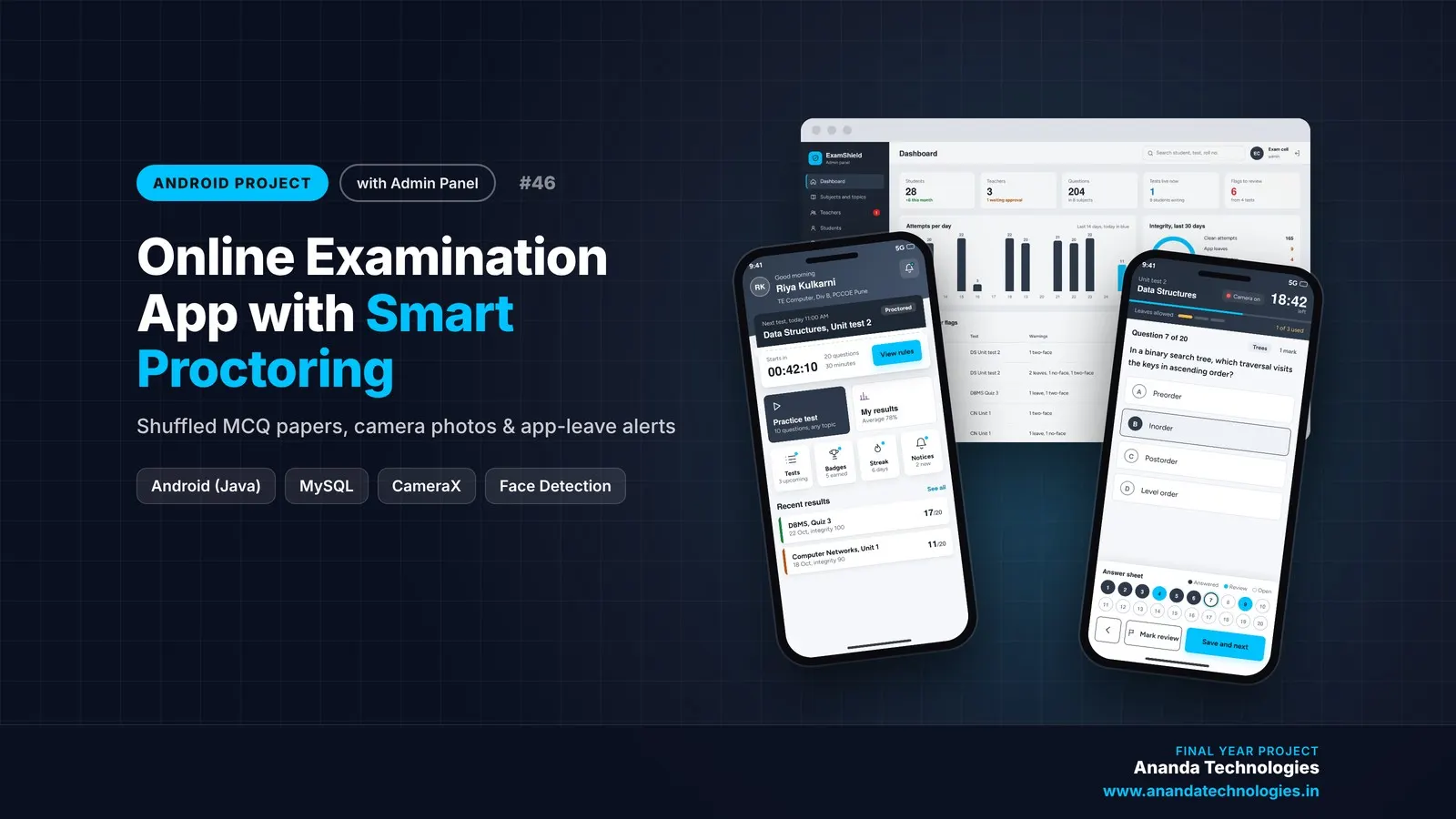
- Online Examination App with Smart Proctoring – clear test cases and evaluation parameters.
- Library Management Android App with Barcode – simple to demonstrate in the oral.
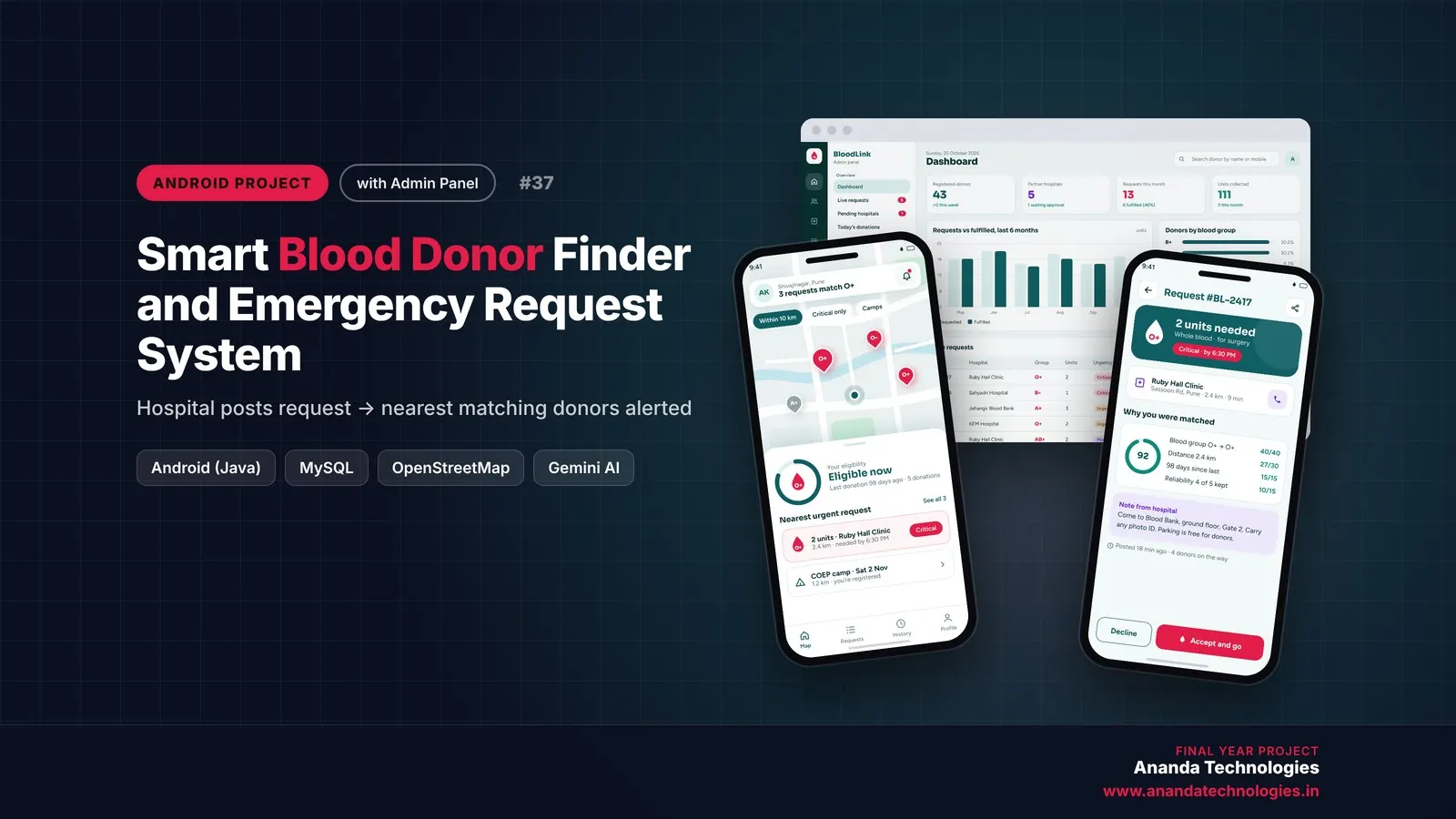
- Blood Donor Finder with Emergency Request – strong social-impact angle.
- Smart Parking Slot Booking Android App – good for design and database chapters.
- College Feedback and Survey Portal – results can be shown as charts.
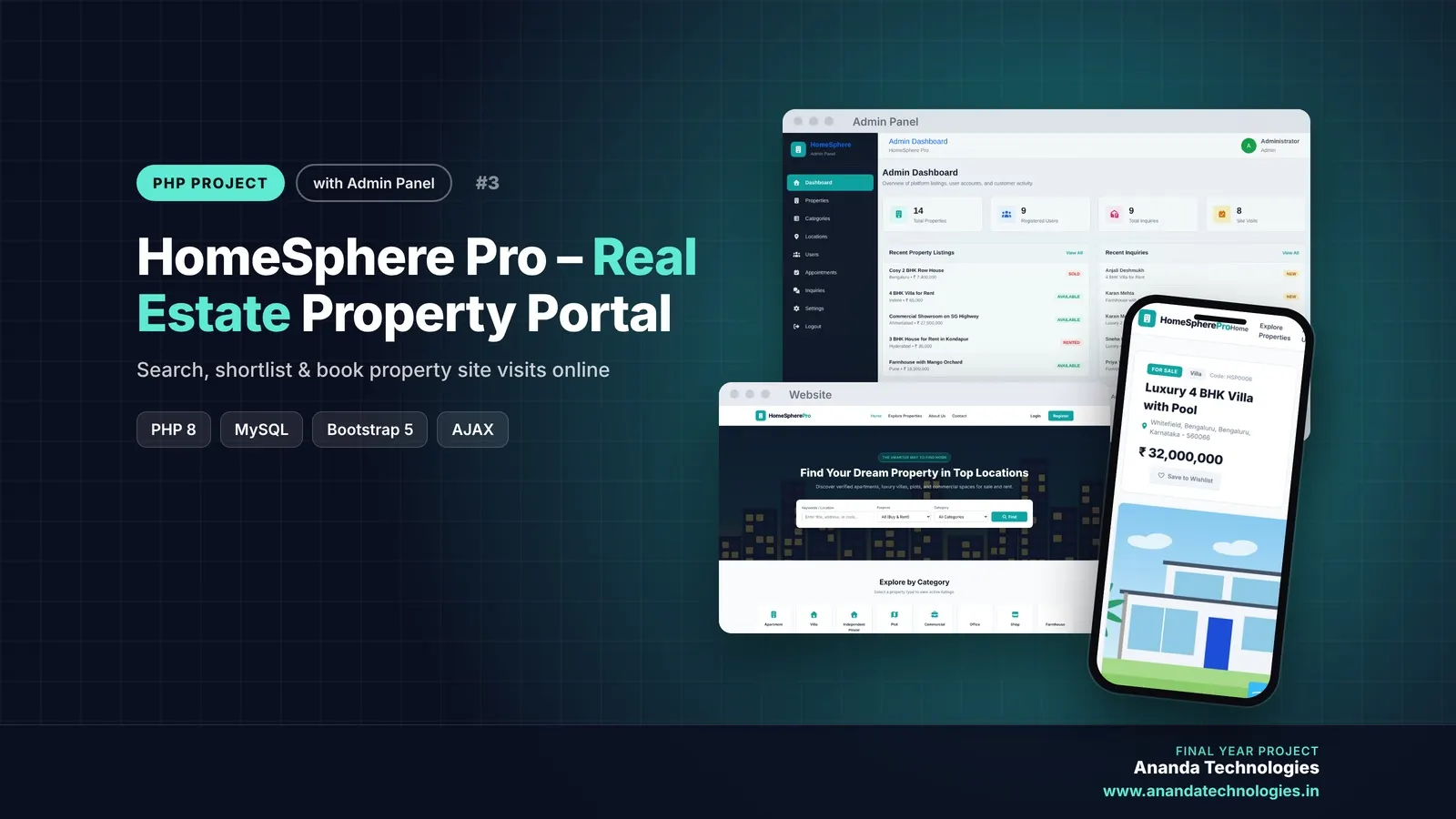
- Real Estate Property Portal (PHP) – full web stack with admin panel.
Each project page has a free abstract, screenshots and a report preview, so you can check the structure before deciding. Whatever you choose, make sure your group understands the code, because the examiners will ask questions on it.
Related guides
Final year projects for Mumbai students
If you study in a Mumbai University engineering college, our final year projects in Mumbai page lists ready projects with source code, report and setup help for Computer and IT students. You can also browse all BE/BTech projects.
Frequently asked questions
What is the black book in Mumbai University engineering?
It is the common name for the final hard-bound Major Project 2 report submitted in Semester VIII of BE/BTech. The MU syllabus lists "Project Report (Black Book) (both side print)" as one of the items used to award term work marks.
Which chapters should a Mumbai University black book have?
The syllabus suggests at least: Abstract, Introduction, Literature Survey/Existing System, Limitations or Research Gap, Problem Statement and Objectives, Proposed System, Experimental Setup, Results and Discussion, Conclusion and Future Work, References, and an Appendix with publications or certificates.
Is there one official font and margin template for the black book?
The syllabus asks for the report as per University of Mumbai guidelines but does not print one font and margin template for every college. Use the template your department or project coordinator gives you.
What else do we submit with the black book?
For Major Project 2 the syllabus asks each group to submit a soft copy of the report along with project documentation, implementation code, required utilities, software and user manuals.