Final Year Projects
SPPU MCA Project Guide: Mini Project, Research Project and Internship (Pattern 2024)
SPPU MCA project work explained semester-wise for Pune students: Mini Projects in Sem I and II, the RP31 Research Project with paper and report rules, and the Sem IV internship.
6 min read · updated
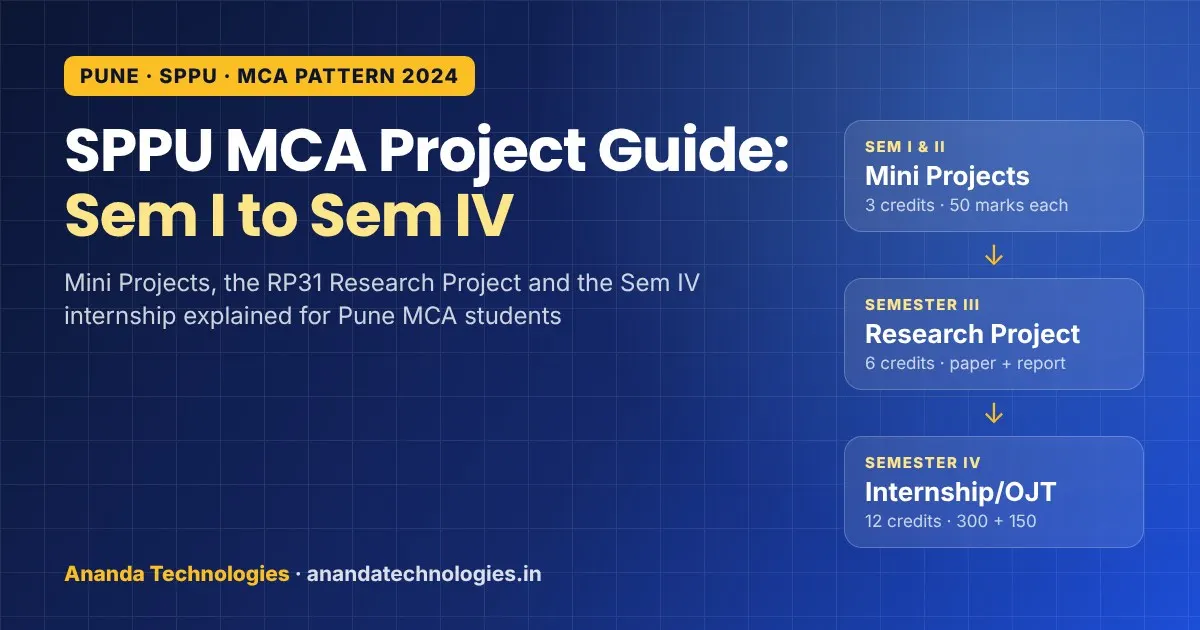
If you are studying MCA in a Pune college, the SPPU MCA project work is not one single project. Under the SPPU MCA Pattern 2024 curriculum (Commerce & Management faculty), you do a Mini Project in Semester I and again in Semester II, a Research Project in Semester III and a full-semester Internship/Project Work in Semester IV. Each one is marked differently and expects a different kind of output. This guide explains all four, using the official curriculum, so you can plan your two years instead of rushing in the last month.
One note first: autonomous institutes in Pune (and the SPPU university department) run their own MCA regulations. Everything below is for SPPU-affiliated MCA colleges following Pattern 2024. If your college is autonomous, check your own syllabus book.
The four project courses at a glance
| Semester | Course (code) | Credits | Marks | What you deliver |
|---|---|---|---|---|
| I | Mini Project (ITC11) | 3 | 50 internal | A working application + documentation |
| II | Mini Project (ITC21) | 3 | 50 internal | A working application + documentation |
| III | Research Project (RP31) | 6 | 100 internal | Research report + paper presented or published |
| IV | Internship/Project Work – FP/OJT (IT41) | 12 | 300 external + 150 internal | Industry internship or project work |
Semester IV also has two MOOC courses (MC41 and MC42, 3 credits and 50 internal marks each). The whole programme is 95 credits.
Semester I and II: the Mini Projects
The curriculum describes the Mini Project as an assignment you complete at the end of each first-year semester to strengthen your fundamentals by applying what you learned. Each Mini Project carries 3 credits and 50 internal marks, with 45 hours listed in the teaching scheme.
The course outcomes tell you what your guide will look for:
- applying software engineering principles while designing and building the project,
- a functioning application that meets the stated requirements,
- documentation covering requirements, design, implementation details, testing and a user manual.
The objectives also mention presentation skills and teamwork (division of tasks, coordination), so expect a presentation and questions on who did what.
What works well here: a clean CRUD-plus-workflow web application in a stack you studied that semester. In Semester I that is often Python or a web stack; Semester II adds Java and, depending on your electives, JavaScript or Advance Web Development. Pick a problem with clear users and 2–3 roles (user, admin, maybe vendor), not a giant system.
Ideas at the right size, all PHP + MySQL with user and admin panels:
- ForkTale – Recipe Sharing Portal: users post recipes, others rate and save them, admin moderates.
- FarmCrate – Online Vegetable Ordering System: catalogue, cart, order status and delivery slots.
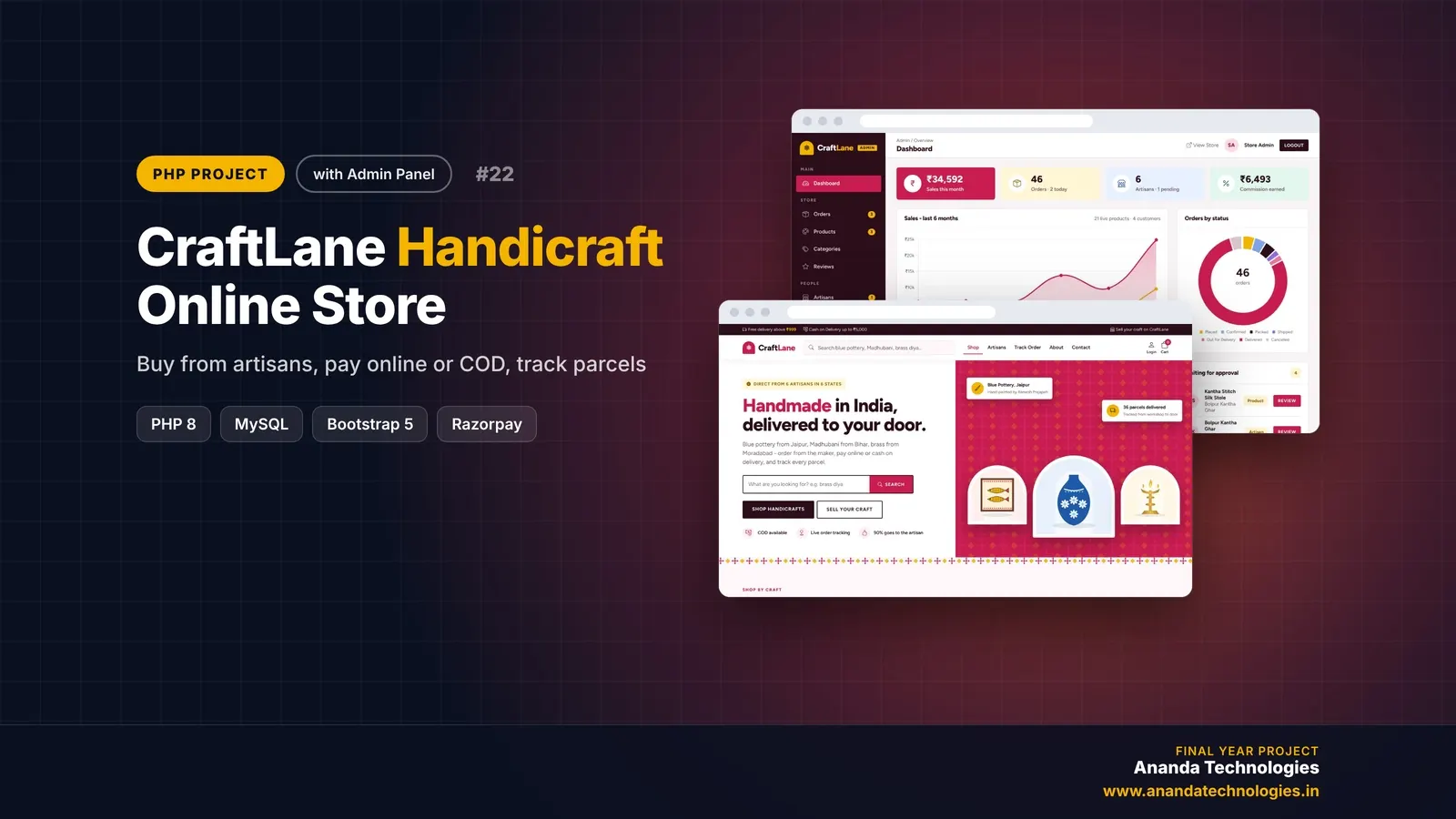
- Handicraft Online Store: a small e-commerce flow with seller listings.
- EventSphere – Wedding Venue Booking System: date-wise availability, booking and enquiry management.
Use the Mini Project to practise documentation. The SRS, ER diagram, DFD/UML and test cases you write now are the same skills Semester III and IV expect.
Semester III: the Research Project (RP31)
This is the part most Pune MCA students underestimate. RP31 is 6 credits and 100 internal marks, and it is a research project, not just another app. You study Research Methodology (RM21) in Semester II to prepare for it.
Key points from the official Research Project guidelines:
- You can work alone or in a group of maximum 4 students.
- The work should fall under a research category such as applied, exploratory, empirical, survey-based or design & creation.
- Data can be primary or secondary (Kaggle, GitHub, Google Dataset Search, IEEE DataPort, government repositories), preferably post-2020.
- The literature survey must include at least 25 research publications from reputed sources.
- You must present or publish the work in a recognised journal or conference.
- Plagiarism limit: ≤10% for text-based research and ≤15% for coding-based research, checked with tools like Turnitin or DrillBit.
- Report format: Times New Roman, 12 pt body, 14 pt headings, 1.5 line spacing, justified; references in APA style.
How RP31 is evaluated
| Parameter | Weight |
|---|---|
| Originality of proposed work | 10% |
| Literature survey | 10% |
| Proposed work | 10% |
| Results obtained | 10% |
| Detailed report | 30% |
| Work presented/published | 20% |
| Final presentation | 10% |
Notice that the report (30%) and publication (20%) together are half the marks. A good model with a weak report and no paper will score poorly.
The report template in the curriculum includes a cover page, certificates (completion, presenter's and publisher's certificates, separate for each student), a self-declaration and plagiarism report, then chapters: Introduction (problem statement, objectives, hypothesis, significance), Review of Literature, Research Methodology/Design, Proposed Work, Results and Discussion, Findings and Suggestions, Future Scope, Limitations, References and Annexure.
Choosing an RP31 topic
Pick a problem where you can measure something: accuracy, precision/recall, time taken, or a comparison of two methods on the same dataset. That gives you a Results chapter and a paper. Examples from our catalogue that fit a research-style project:
- Fake News Detection using Machine Learning – compare classical ML models on a public news dataset.
- Network Intrusion Detection (XGBoost + RFE) – feature selection and model comparison on a benchmark dataset. This is an M.Tech-depth build, so it is research-heavy.
- Code Vulnerability Detection with GNN – also M.Tech-depth; good if your elective was Deep Learning or a security subject.
Whatever topic you choose, you must write the paper and report in your own words and understand the method well enough to defend it.
Semester IV: Internship / Project Work (IT41)
Semester IV is almost entirely the FP/OJT course: 12 credits, 300 external + 150 internal marks. The curriculum says it is conducted in the final semester and evaluated at the end of it. Most Pune students do this as an internship at a company; others do project work as allowed by their institute.
The detailed IT41 rules (duration, company letter, report and viva arrangement) are set out by the university and your institute, so ask your training and placement or project coordinator early, ideally during Semester III. Practical tips:
- Start applying for internships while RP31 is still running.
- Keep a weekly log of what you work on; it makes the report easy.
- Get the company certificate and joining letter in the format your college asks for.
- Prepare for the external viva on your own module: architecture, database, the screens you built and the problems you solved.
Do not forget the two MOOCs in Semester IV. Finish them early so they do not clash with your internship deadline.
A simple two-year plan
- Sem I: small web app Mini Project; learn Git and basic SRS/UML.
- Sem II: second Mini Project with Java or a JS framework; take Research Methodology seriously and start collecting papers.
- Sem III: RP31 – topic by the first month, 25+ papers, experiments, paper submitted before the report deadline.
- Sem IV: internship + MOOCs; final report and viva.
For report writing help, our SPPU project report format guide explains chapter structure, and final year project viva questions lists the questions examiners usually ask. More topic ideas are in MCA final year project ideas for Pune and Mumbai.
Help for Pune MCA students
If you want a ready project base to learn from, you can browse all MCA projects. Every project page shows a free abstract, screenshots and a report preview so you can check the scope before you decide. For college-wise help in the city, see our page on final year projects in Pune.
Frequently asked questions
How many projects are there in SPPU MCA Pattern 2024?
Four project courses: Mini Project ITC11 in Semester I and ITC21 in Semester II (3 credits, 50 internal marks each), Research Project RP31 in Semester III (6 credits, 100 internal marks) and Internship/Project Work IT41 in Semester IV (12 credits, 300 external + 150 internal marks).
Is publishing a paper compulsory for the SPPU MCA Research Project?
The official RP31 guidelines say students or groups must present or publish their research in a recognised journal or conference, and "work presented/published" carries 20% of the evaluation. Confirm the accepted venues with your guide.
What is the group size and plagiarism limit for SPPU MCA RP31?
You can work alone or in a group of maximum 4 students. The plagiarism limit is 10% or less for text-based research and 15% or less for coding-based research, checked with tools like Turnitin or DrillBit.
Does this apply to autonomous MCA colleges in Pune?
No. This guide follows the SPPU MCA Pattern 2024 curriculum for affiliated colleges. Autonomous institutes and the university department follow their own regulations, so check your own syllabus book.