Final Year Projects
Final Year Project Guide for Nashik BE/BTech Computer & IT Students (SPPU)
A final year project guide for BE/BTech Computer, IT and AI & DS students in SPPU colleges in Nashik: Stage I and II rules, marks, a month-by-month plan and project ideas that suit Nashik.
5 min read · updated
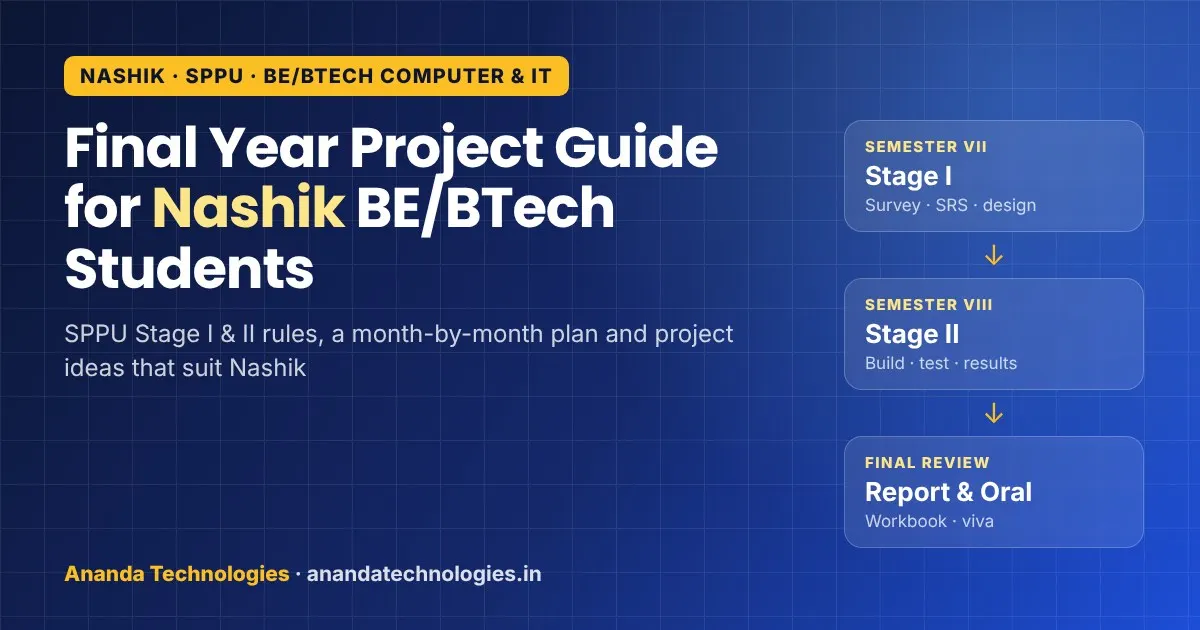
This final year project Nashik guide is for BE/BTech Computer Engineering, IT and AI & DS students in SPPU-affiliated colleges across Nashik city, Sinnar, Chandwad, Igatpuri and the rest of the district. You follow the same Savitribai Phule Pune University scheme as Pune students, so the rules below are the same — but the topics that impress a Nashik panel can be a little different.
If your college is autonomous, it sets its own project scheme. Treat the numbers below as the SPPU affiliated-college pattern and confirm with your project coordinator.
Which SPPU scheme applies to your batch
SPPU is moving engineering to the NEP-compliant 2024 Pattern year by year. The official TE Computer Engineering 2024 Pattern curriculum (draft, May 2026) is "with effect from Academic Year 2026-27", which means the third-year batch of 2026-27 is on the new pattern. If you are in final year in 2026-27, you are still on the 2019 Course for BE/BTech Computer Engineering. Always check the scheme printed on your own marksheet.
For BE/BTech Computer Engineering (2019 Course), the official syllabus gives:
| Semester | Course | Hours / week | Credits | Marks |
|---|---|---|---|---|
| VII | 410248 Project Stage I | 2 (practical) | 2 | 50 |
| VIII | 410256 Project Stage II | 6 | 6 | TW 100 + 50 = 150 |
IT and AI & DS have their own codes and hours (for example, IT 414448 / 414456 and AI & DS 417527 / 417536). We covered them in the SPPU BE/BTech IT guide and the AI and ML projects for SPPU post.
What you submit in Stage I and Stage II
Stage I (Semester VII)
The SPPU guidelines say Stage I covers the problem statement, literature review, SRS, model and design, and you should finish at least up to the design phase. You also give a presentation on the latest technology related to your topic. A panel that includes one external examiner assesses your work, content delivery, presentation, documentation, question-answers and report. For a step-by-step plan, read our SPPU Project Stage 1 guide.
Stage II (Semester VIII)
Stage II covers the selection of technology and tools, installation, UML implementation, testing, results, performance discussion with data tables, comparison with existing systems, and validation of results. You submit a report in standard format, certified by your guide and HOD. Both stages say to follow the Project Workbook recommended by the Board of Studies — so keep your workbook updated after every review.
The report chapters and formatting are explained in our SPPU project report format post.
A month-by-month plan for Nashik students
Many Nashik students travel daily from Sinnar, Niphad, Dindori or Igatpuri, so the time left after college is short. A simple plan keeps the project on track:
- July–August: form your group, shortlist 3 topics, read 10–15 recent papers, and agree on one problem statement with your guide.
- September–October: write the SRS, draw UML / DFD diagrams, design the database and screens, and prepare the Stage I presentation.
- November–December: Stage I review, then start the build — login, core module and database first.
- January–February: finish all modules, collect test data and run your comparison (old method vs your method).
- March–April: testing, result tables and graphs, report, paper (if your department asks), and final Stage II review and oral.
Exact review dates differ from college to college, so match this plan with your department's calendar.
Project ideas that suit Nashik
Nashik district is known for grapes, onions and vegetable farming, along with a large industrial belt at Satpur, Ambad and Sinnar. A topic that solves a local problem is easy to explain in the viva, and examiners usually like real data. A few ideas that fit SPPU's Stage II requirement of "results and comparative analysis":
Agriculture and AI
- Crop recommendation and yield prediction — Android app with on-device Random Forest; compare it with another algorithm for your result chapter.
- Plant leaf disease detection using deep learning — on-device CNN; you can test it on leaf photos from your own area.
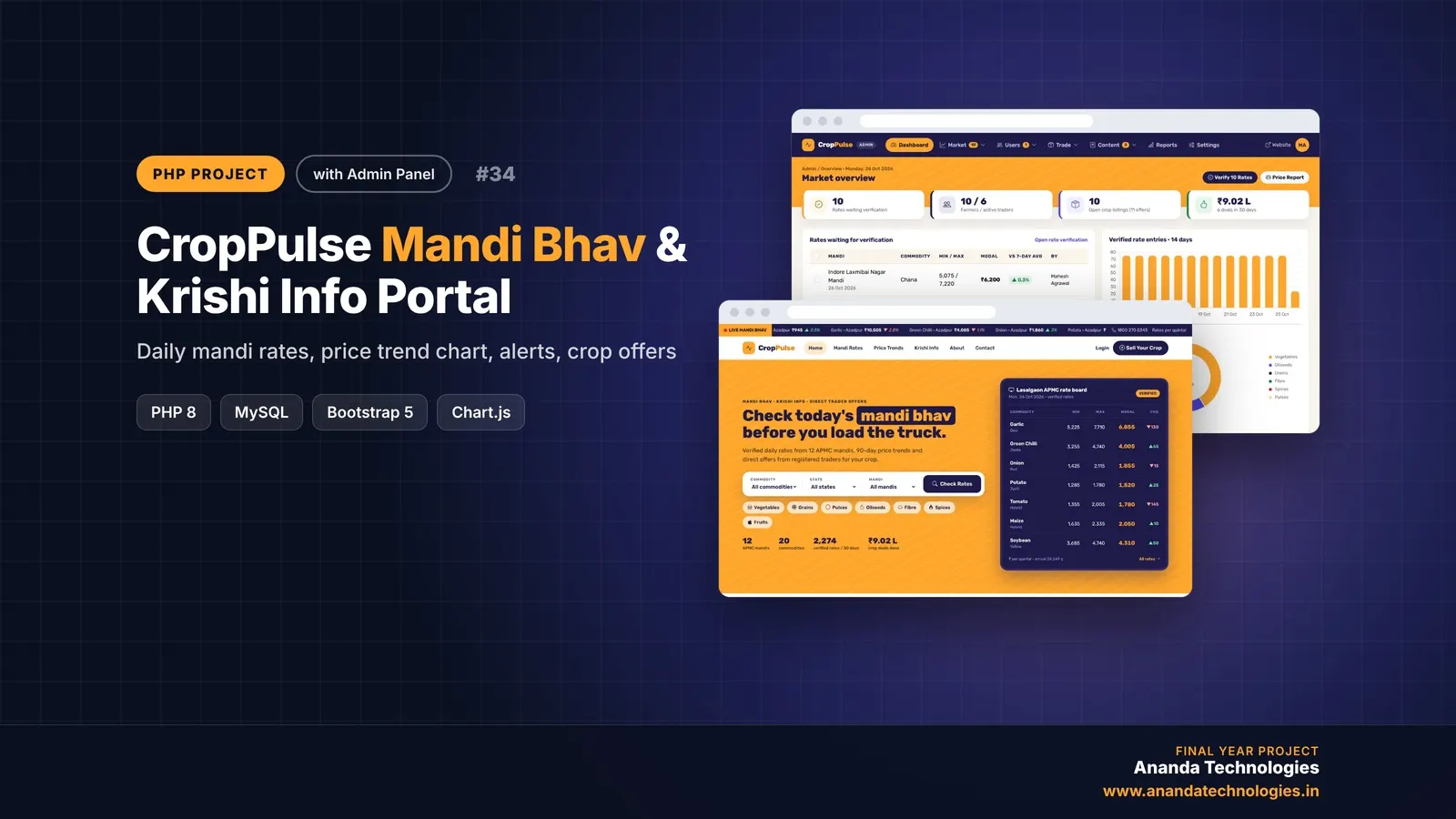
- Agriculture market price portal — PHP + MySQL portal with mandi rates, price trend charts and alerts; a good base if you want to add price forecasting with ML.
Campus and city problems
- Face recognition based smart attendance — measure accuracy in different light conditions for your results.
- Fake news detection using machine learning — useful for comparing classifiers (accuracy, precision, recall).
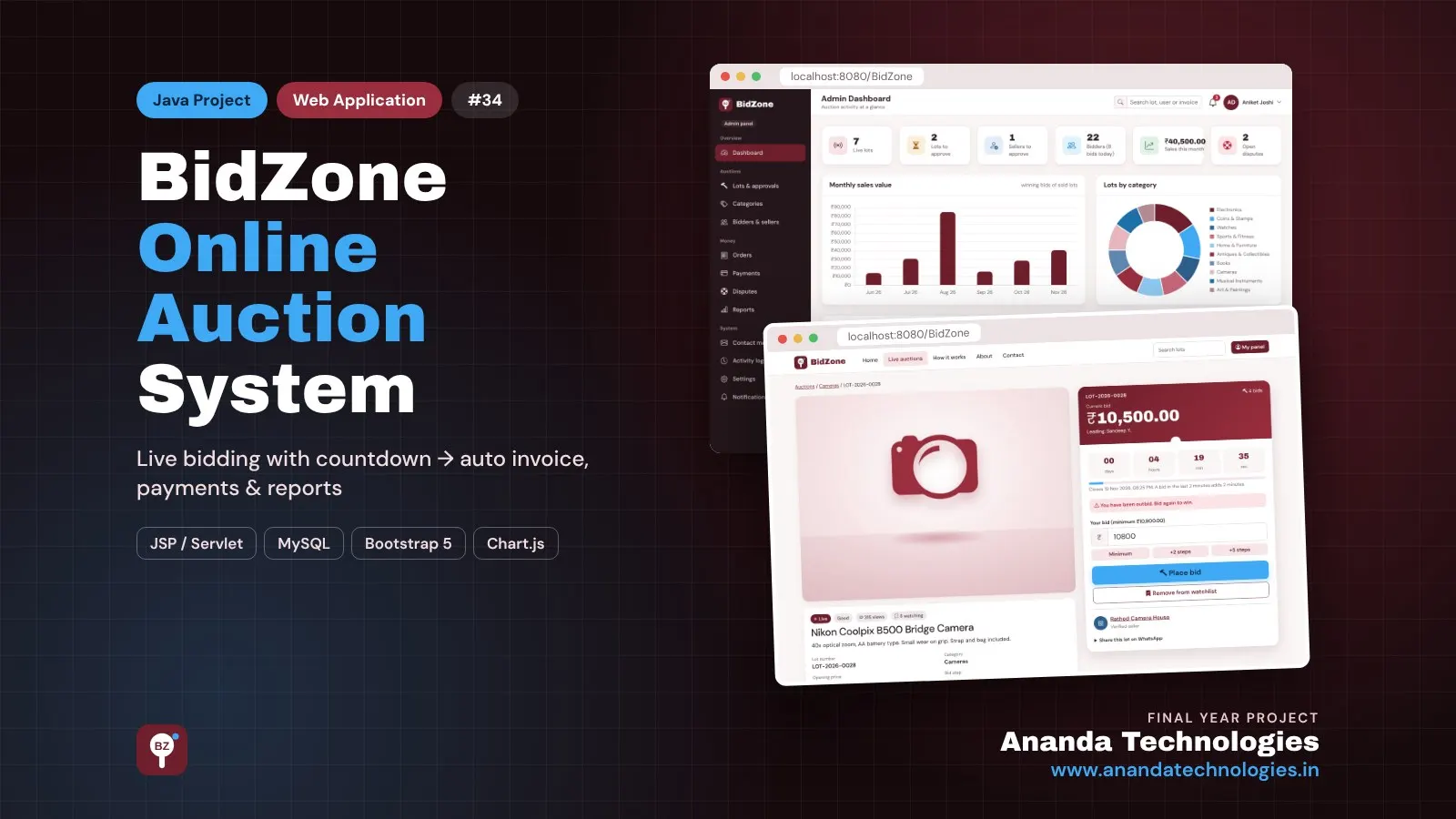
- Online auction system (Java, JSP, Servlet, MySQL) — a Java web base; for a BE/BTech panel, add a feature such as fraud-bid detection or price prediction so it is not "just CRUD".
Research-heavy option
- Network intrusion detection (XGBoost + feature selection) — this is an M.Tech-depth build. Choose it only if your group is comfortable with datasets, model tuning and writing a strong results chapter.
More topics are in our BE/BTech Computer Engineering project ideas for SPPU colleges and the full BE/BTech project list.
Tips that help in the Nashik viva
- Know your data. If you used a dataset, say where it came from, how many records it has and how you split it for training and testing.
- Show a comparison. SPPU's Stage II guidelines ask for comparison with existing systems — one table with 2–3 methods is enough.
- Every member should know the whole project. Examiners often ask each student a question from a module they did not build.
- Keep the workbook signed. A missing guide signature before the external review is a common, avoidable problem.
- Practise common questions. Our final year project viva questions list has the questions panels ask most.
Getting help with your project in Nashik
If your group wants a ready base to study and extend, our final year projects in Nashik page lists Computer, IT and AI projects with source code, report and setup help. Before you pay, you can see the free abstract, screenshots and a report preview of each project. Students in nearby SPPU colleges can also check the Pune final year projects page.
Whatever you choose, understand the code, run it yourself and be ready to explain every screen — that is what the examiner checks.
Frequently asked questions
Do Nashik engineering colleges follow the same project rules as Pune colleges?
Yes, if your college is affiliated to Savitribai Phule Pune University. Nashik and Pune affiliated colleges follow the same SPPU scheme. Autonomous colleges set their own scheme, so confirm with your project coordinator.
How many marks does the SPPU BE/BTech Computer Engineering final year project carry?
For the 2019 Course, 410248 Project Stage I in Semester VII has 2 credits and 50 marks, and 410256 Project Stage II in Semester VIII has 6 credits with 100 term work and 50 presentation marks. IT and AI & DS have their own course codes, so check your syllabus.
What should be ready by the end of Project Stage I?
SPPU guidelines say Stage I should cover the problem statement, literature review, SRS, model and design, with the project complete at least up to the design phase, plus a presentation on the latest technology related to your topic.
Can we buy a ready project and use it for our Nashik college?
You can use a ready project as a base to study and extend, but you must understand and explain the code in the viva. With Ananda Technologies you can check the free abstract, screenshots and a report preview before you pay.