Final Year Projects
AI and ML Project Ideas for SPPU BE/BTech Students in Pune
AI and ML project ideas for SPPU BE/BTech Computer, IT and AI & DS students in Pune, grouped by final year subjects, with Stage I and II marks and a simple plan.
6 min read · updated
Picking AI ML projects SPPU examiners will take seriously is harder than it looks. Almost every BE/BTech group in Pune now wants "something with AI", so the topic alone no longer impresses anyone. What does impress a panel is a project that clearly connects to your syllabus, uses a real dataset, and shows results you can explain. This guide is for BE/BTech students of Computer Engineering, IT, AI & Data Science and AI & ML in SPPU-affiliated colleges. It covers where AI and ML sit in your final year, how Project Stage I and II are assessed, and project ideas grouped by the subjects you actually study.
One note first: the course codes and marks below come from the official SPPU 2019 (Computer) and 2020 (AI & Data Science) course syllabi. Autonomous colleges in Pune and the newer NEP batches can follow a different scheme, so always confirm with your own syllabus and project coordinator.
Where AI and ML sit in the SPPU final year
You do not need to go outside your syllabus to find a good AI topic. The final year already pushes you in that direction.
BE/BTech Computer Engineering (2019 course): Machine Learning is a core subject in Semester VII, and Deep Learning is part of Semester VIII. Project Stage I and Project Stage II run across both semesters.
BE/BTech AI & Data Science (2020 course, with effect from 2023-24): Semester VII has Machine Learning (417521) and Data Modeling & Visualization (417522), with electives such as Quantum AI, Information Retrieval and Optimization Algorithms. Semester VIII has Computational Intelligence (417530) and Distributed Computing (417531), with electives like Big Data Analytics, Deep Learning, Business Intelligence and Reinforcement Learning.
BE/BTech IT: the final year includes Deep Learning and Information Storage & Retrieval, so NLP and search-based projects fit well.
If your project uses ideas from one of these subjects, your guide will find it easy to accept, and the examiner will find it easy to question you on. That second part matters more than students think.
How Project Stage I and Stage II are marked (AI & DS example)
| Stage | Course | Hours/week | Credits | Marks |
|---|---|---|---|---|
| Sem VII | 417527 Project Stage I | 4 (practical) | 2 | TW 50 + Presentation 50 = 100 |
| Sem VIII | 417536 Project Stage II | 12 (practical) | 6 | TW 100 + Oral 50 = 150 |
For Computer Engineering (2019 course), Project Stage I is 2 credits with 50 marks of term work, and Stage II is 6 credits with 100 term work + 50 oral. Our SPPU Project Stage I guide explains that stage in detail.
The SPPU guidelines say Stage I should cover the problem statement, literature review, SRS, model and design, and that you present on recent advances in technology related to your topic. An external examiner sits on the panel. Stage II asks for tools, implementation, testing, results shown in data tables, and a comparison with existing algorithms or systems. For an AI project, that last line is the key: you must compare your model with something, not just show that it runs.
What makes an AI/ML project strong for SPPU
Before the ideas, here is what separates an average AI project from a good one:
- A clear dataset. Name it in your SRS: a public dataset (Kaggle, UCI, PlantVillage and similar) or data you collect yourself. Say how many samples and classes it has.
- A baseline and a comparison. Train at least two approaches, for example Random Forest vs a neural network, and put accuracy, precision, recall and F1 in a table. This is exactly the "comparative analysis" Stage II asks for.
- A usable front end. A model inside a notebook is not a project. Wrap it in an Android app or web app with a simple admin panel so it looks like a real system.
- Honest limits. Say where the model fails (poor lighting, small dataset, regional language). Examiners respect this.
- Your own understanding. Every member should be able to explain the training process, the confusion matrix and why you picked the model.
AI and ML project ideas by subject
Machine Learning (Sem VII)
Classic supervised learning on tabular data is perfect for showing preprocessing, feature selection and model comparison.
- Crop recommendation and yield prediction: Random Forest running on the phone, with yield prediction and fertiliser advice. Easy to compare with Decision Tree or Naive Bayes.
- Heart disease risk prediction: a health dataset, on-device ML and a risk report PDF. A good fit if your group likes healthcare topics.
Deep Learning and computer vision (Sem VIII)
Image-based projects give you training curves and visual results that look good in a presentation.
- Plant leaf disease detection: a CNN running on the phone, with severity levels. You can compare a small custom CNN against a transfer-learning model.
- Indian Sign Language to text and speech: live ISL recognition with MediaPipe and ML. Strong social impact, which panels like.
- Driver drowsiness detection: eye and yawn detection with an alarm and SOS. Easy to show live in the oral.
NLP and information retrieval
These suit IT students (Information Storage & Retrieval) and AI & DS students who choose the Information Retrieval elective.
- Fake news detection: text classification on the phone with TFLite. Compare TF-IDF + Logistic Regression with a neural model.
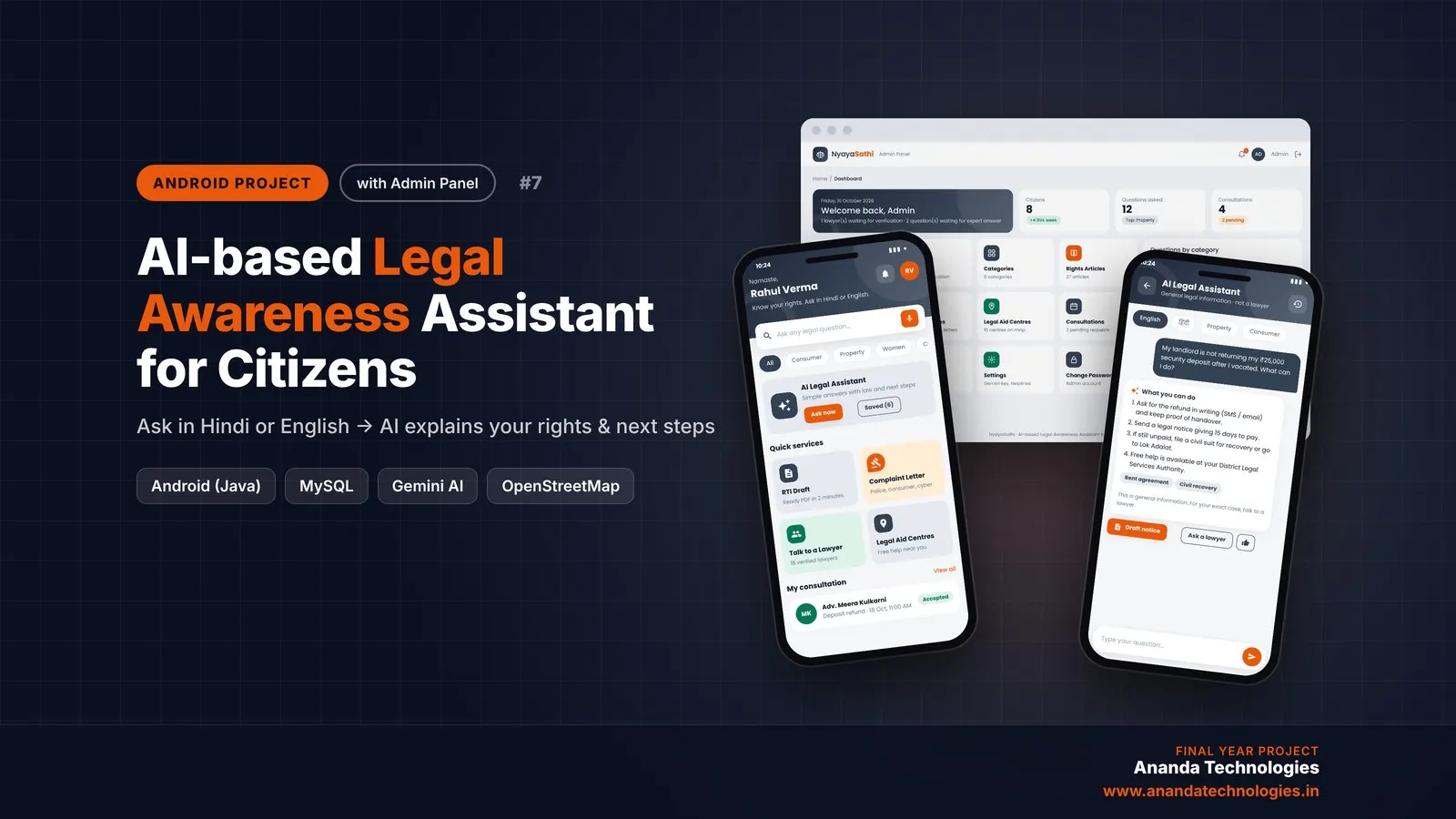
- AI legal awareness assistant: a Gemini-powered legal Q&A in Hindi with RTI drafts. A good example of using a large language model responsibly, with clear limits.
Research-heavy options
If your group wants to publish a paper (many SPPU colleges encourage this in the final year), look at our M.Tech-depth builds. They are made for postgraduate research, so they come with a base paper and a deeper model, and they need more effort to understand: chest X-ray pneumonia detection with CNN-ViT and code vulnerability detection with graph neural networks and CodeBERT. Pick one only if your team is comfortable with Python and research papers.
You can see all our AI work on the AI & ML projects page, and more topic ideas in 12 AI project ideas for final year students and BE/BTech Computer Engineering project ideas for SPPU colleges.
A simple plan across the two semesters
- Sem VII, first month: finalise the topic with your guide, collect 10–15 recent papers, choose the dataset.
- Sem VII, rest: write the literature survey and SRS, draw the architecture and UML diagrams, train a first baseline model for your Stage I presentation.
- Sem VIII, first half: build the full app, train the final model, run experiments and fill the comparison tables.
- Sem VIII, second half: testing, report in your department's format, paper submission if your college asks for it, and viva practice.
Starting the dataset work in Semester VII is the single best thing you can do. Most AI projects get delayed because data cleaning takes longer than expected.
Getting help in Pune
If you want a ready base to learn from, our BE/BTech projects come with a free abstract, screenshots and a report preview, so you can judge a topic before deciding. Students from Pune and Pimpri-Chinchwad can see the full list on our final year projects in Pune page. Whichever project you choose, make sure your whole group understands the model and the results, because that is what the SPPU panel will test.
Frequently asked questions
Which AI ML projects are good for SPPU final year students?
Projects that link to your final year subjects work best: Machine Learning projects on tabular data (crop or disease prediction), Deep Learning projects on images (plant disease, sign language), and NLP projects (fake news detection). Pick one with a clear dataset and compare at least two models.
How many marks is the SPPU final year project for BE/BTech AI & Data Science?
Under the SPPU AI & DS 2020 course, Project Stage I (417527) is 2 credits with 50 term work and 50 presentation marks, and Project Stage II (417536) is 6 credits with 100 term work and 50 oral marks. Check your own syllabus if your college is autonomous or on the NEP scheme.
Do SPPU examiners expect a comparison of models in an AI project?
Yes. The Stage II guidelines ask for results in data tables and a comparative analysis with existing algorithms or systems. For an AI project, show accuracy, precision, recall and F1 for your model against at least one baseline.
Can BE/BTech Computer and IT students also do AI and ML projects?
Yes. Computer Engineering students study Machine Learning in Semester VII and Deep Learning in Semester VIII, and IT students have Deep Learning and Information Storage & Retrieval. AI topics fit both branches as long as the project is clearly linked to those subjects.