Final Year Projects
Mumbai University MCA Project Guide: Mini, Research & Internship
A semester-wise guide to the Mumbai University MCA project under the NEP syllabus: Mini Projects 1A and 1B, the Sem III Research Project, the Sem IV Internship Project, marks, and topic ideas.
5 min read · updated
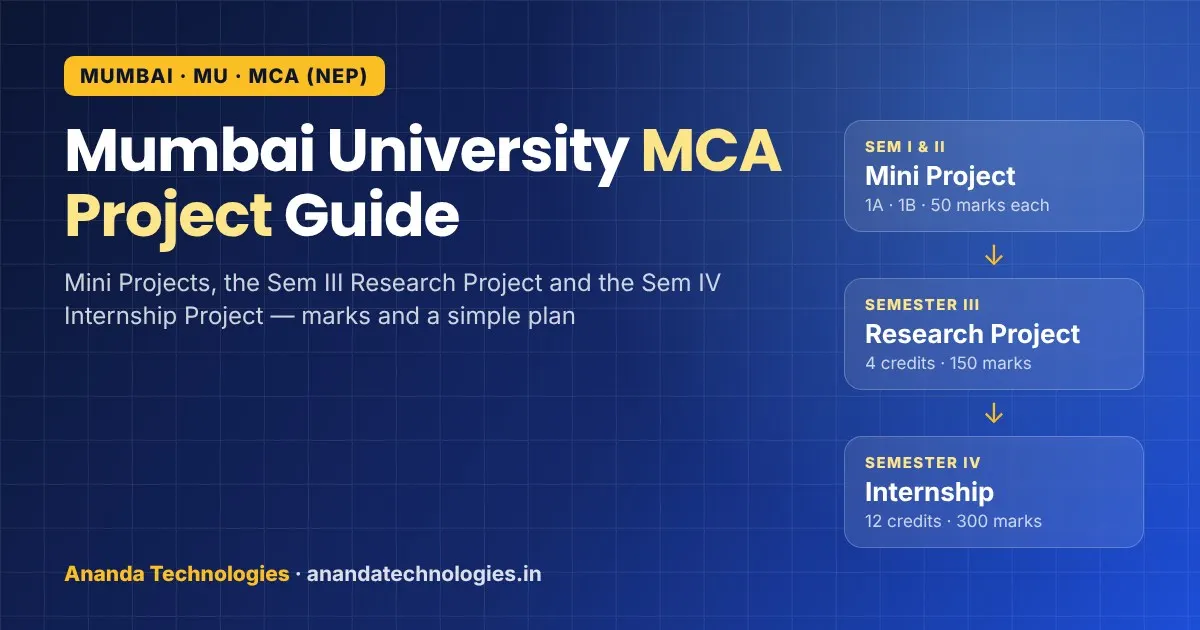
The Mumbai University MCA project is not one single project any more. Under the two-year MCA NEP syllabus of the University of Mumbai (with effect from 2024-25, progressively), project work is spread across all four semesters: two small mini projects in the first year, a Research Project in Semester III, and a full-semester Internship Project plus a research paper, product or patent in Semester IV. This guide explains what each stage asks for, how marks are split, and how MCA students in Mumbai, Thane and Navi Mumbai colleges can plan the work without a last-minute rush.
A quick note before we start: the numbers below come from the official MU MCA (Two Year) NEP syllabus document. Autonomous institutes in Mumbai often run their own MCA scheme, so if your college is autonomous, check your own syllabus and ask your project coordinator.
The four project stages at a glance
| Semester | Course | What it is | Credits | Marks |
|---|---|---|---|---|
| Sem I | MCAP11 Mini Project – 1A | Small group project, 2 contact hours/week | 1 | 50 (TW 25 + Oral 25) |
| Sem II | MCAP21 Mini Project – 1B | Second mini project | 1 | 50 (TW 25 + Oral 25) |
| Sem III | MCARP31 Research Project (RP) | Research-based project after Research Methodology | 4 | 150 (TW 75 + Practical/Oral 75) |
| Sem IV | MCAIP41 Internship Project (OJT) | One semester in industry building a software system, 40 hours/week | 12 | 300 (Mid-term 75 + 75, Final 150) |
| Sem IV | MCARP42 Research Paper / Product / Patent | Output of your research work | 2 | 100 (50 + 50) |
Semester IV also carries 6 credits of MOOC (SWAYAM-NPTEL and similar). Together, the full two-year programme adds up to 93 credits.
Mini Project 1A and 1B (Semester I and II)
The mini projects are where you learn the project routine. The syllabus guidelines are clear:
- Groups of 2 to 3 students.
- Identify a real need through a survey and turn it into a problem statement with your guide.
- Submit an implementation plan as a Gantt, PERT or CPM chart covering weekly work.
- Keep a log book of weekly progress that your guide checks and signs.
- Propose more than one solution, pick the best one with your guide, and build a working model.
- Write the report in the standard University of Mumbai format.
How the 50 marks are given
Term work (25) is split as 10 marks from the guide based on the log book, 10 marks for your own contribution and use of skills, and 5 marks for report quality. The oral (25) happens at institute level, often with alumni or industry experts on the panel. They look at the quality of your survey, clarity of the problem, innovation, feasibility, cost effectiveness, societal impact, a fully working model, and how clearly you communicate.
Good mini project topics usually come from your first-year subjects: Advanced Java, Advanced DBMS, Web Technologies, Software Project Management, AI and ML, Advanced Web Technologies, DevOps and UI design. A web portal with a proper admin panel, or a small ML model wrapped in a simple app, fits well. For example, a team task tracker with a Kanban board is a natural match for Software Project Management, and an online eyewear store with cart and order tracking covers Web Technologies and DBMS together.
Research Project (Semester III)
Semester II has a 4-credit Research Methodology course, and Semester III puts it to use in the Research Project (MCARP31) worth 4 credits and 150 marks. Your college will give you its own format for reviews and the report, but in practice the RP is judged on research quality, not just on a working app:
- Pick a problem with a clear research question, not just "make a website".
- Read recent papers and write a short literature review.
- Build or reproduce a method, test it on a dataset, and compare results.
- Present findings with tables and graphs, and discuss limits.
Semester III subjects give you strong directions: Big Data Analytics and Visualization, Computer Vision, Deep Learning, Cloud Computing, Software Testing, Ethical Hacking, Blockchain and the Mobile Computing Lab. Some ideas that fit:
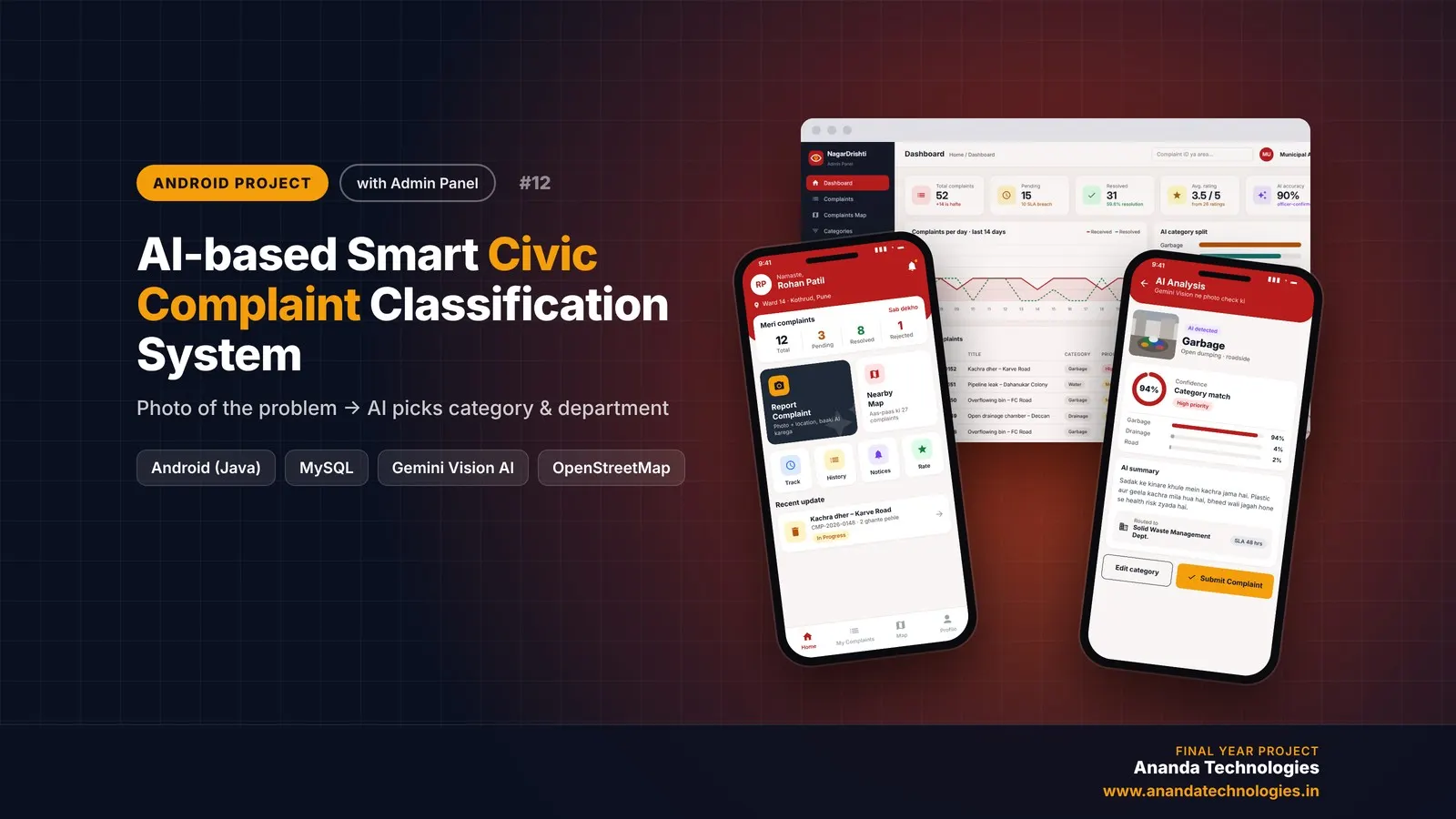
- Text classification with NLP, like an AI civic complaint classification system.
- Security and ML together, like spam SMS and phishing URL detection.
- Educational data mining, like student performance prediction with early warnings.
If you want a more research-heavy topic, our M.Tech-depth builds are worth a look. They are made for postgraduate research work, so they suit an MCA Research Project that needs a dataset, a model and a comparison: network intrusion detection with XGBoost and feature selection and medical report analysis using RAG.
Internship Project and Research Paper (Semester IV)
The syllabus says every MCA student has to spend one semester in industry developing a software system. That is the Internship Project (MCAIP41): 40 hours a week, 12 credits, 300 marks. Evaluation is through presentations: two internal mid-term presentations of 75 marks each and a final university presentation of 150 marks.
Tips for this stage:
- Start looking for an internship in Semester III. Companies in Mumbai and Pune fill MCA intern seats early.
- Make sure the work is real software development you can explain: modules, database design, testing.
- Keep weekly notes. The mid-term presentations are much easier when you can show steady progress.
- Collect your company certificate and any letters your college asks for well before the final presentation.
Alongside the internship, MCARP42 (2 credits, 100 marks) asks for a research paper, product or patent. Many students turn their Semester III Research Project into a paper for this. If you take care with your RP results in Semester III, this part becomes much lighter.
A simple plan for the two years
- Sem I: form a group early, choose a mini project from your subjects, keep the log book from week one.
- Sem II: do Mini Project 1B a level higher than 1A, and use Research Methodology to shortlist RP topics.
- Sem III: finalise the RP topic in the first two weeks, collect data, and start applying for internships.
- Sem IV: work on the internship project full time and write up your research paper or product.
For report structure and viva preparation, our posts on the Mumbai University black book format and final year project viva questions apply to MCA as well. You can also browse MCA final year project ideas for Pune and Mumbai.
Where to find ready project material in Mumbai
If you want a starting point, all our MCA projects come with a free abstract, screenshots and a report preview so you can judge the topic before deciding. Students from Mumbai and nearby areas can see the full list on our final year projects in Mumbai page. Whatever you choose, make sure you understand the code and the research part well enough to explain it in your own words. That is what the examiners check.
Frequently asked questions
How many projects are there in the Mumbai University MCA course?
Under the two-year MCA NEP syllabus there are four project stages: Mini Project 1A (Sem I) and 1B (Sem II), each 1 credit and 50 marks; the Research Project in Sem III (4 credits, 150 marks); and the Internship Project in Sem IV (12 credits, 300 marks), plus a 2-credit research paper, product or patent.
What is the group size for the MU MCA mini project?
The syllabus guidelines say students form groups of 2 to 3. Each group keeps a log book of weekly progress and submits a Gantt, PERT or CPM plan. The oral is held at institute level, often with alumni or industry experts.
Is the Semester IV internship compulsory for Mumbai University MCA students?
Yes. The syllabus says every MCA student has to spend one semester in industry developing a software system. The Internship Project (MCAIP41) is 12 credits and 300 marks, judged through two mid-term presentations and a final presentation.
Does this guide apply to autonomous MCA colleges in Mumbai?
Not fully. Autonomous institutes can have their own MCA scheme, codes and marks. Use this guide as a general picture and always confirm details with your own syllabus and project coordinator.