Final Year Projects
AI and ML Project Ideas for Mumbai University BE/BTech Students
AI and ML project ideas for Mumbai University BE/BTech Computer, AI & DS and AI & ML students, matched to final year subjects, with Major Project marks and viva tips.
5 min read · updated
This guide to AI ML projects Mumbai University students can build is for BE/BTech students in Computer Engineering, CSE (AI & ML), CSE (Data Science), AI & DS and AI & ML branches of colleges affiliated to the University of Mumbai — across Mumbai, Thane, Navi Mumbai, Vasai-Virar, Kalyan and Panvel. It links each idea to the subjects you actually study in final year, so your Major Project and your electives support each other.
If your college is autonomous (several Mumbai colleges now are), it follows its own scheme. Treat the details below as the University of Mumbai affiliated-college pattern and confirm with your project coordinator.
What the MU final year syllabus expects from an AI project
For the final year batch on the Rev-2019 'C' scheme, the official University of Mumbai syllabus gives the same Major Project structure for Computer Engineering and for the AI & DS group of branches (CSE Data Science, CSE AI & ML, AI & DS, AI & ML, Data Engineering):
| Semester | Course | Credits | Marks |
|---|---|---|---|
| VII | CSP701 Major Project 1 | 3 | TW 50 + Oral & Practical 25 = 75 |
| VIII | CSP801 Major Project 2 | 6 | TW 100 + Oral & Practical 50 = 150 |
The Major Project 2 guidelines are very useful for AI students. The report should cover the existing system and its limitations or research gap, the proposed system and algorithm, the experimental set-up, details of the database or input data, performance evaluation parameters for validation, and results and discussion. In the final oral, internal and external examiners use suggested parameters such as relevance to industrial trends, modern tools used, innovation, completeness, validation of results, impact and business value, presentation, and individual plus team work.
In simple words: an AI project at MU is judged on whether you can show your data, your method and your numbers — not only a nice-looking app. For the full Major Project timeline, read our Mumbai University Major Project I and II guide.
Match your project to your final year subjects
Picking a topic close to a subject you study helps a lot in the viva, because the theory is already fresh. According to the official MU syllabus:
- Computer Engineering: Sem VII has Machine Learning (CSC701) and Big Data Analytics (CSC702), with electives such as Machine Vision, Quantum Computing and Natural Language Processing. Sem VIII electives include Deep Learning, Applied Data Science, Optimization in Machine Learning and Social Media Analytics.
- AI & DS group of branches: Sem VII has Deep Learning (CSC701) and Big Data Analytics (CSC702), with electives such as Natural Language Processing, AI for Healthcare and Neural Networks & Fuzzy Systems. Sem VIII has Advanced Artificial Intelligence (CSC801), with electives such as AI for Financial & Banking Applications, Reinforcement Learning, Graph Data Science, Recommendation Systems and Social Media Analytics.
Elective choices differ by college, so check which ones your department offers. The ideas below are grouped by these subjects.
AI and ML project ideas by subject
Natural Language Processing
- AI spoken English tutor — an Android app where the learner talks with a Gemini-based tutor and gets grammar and fluency scores, with a trainer panel. To turn it into a strong NLP project, add your own scoring logic and compare it with the AI's scores on a set of test sentences.
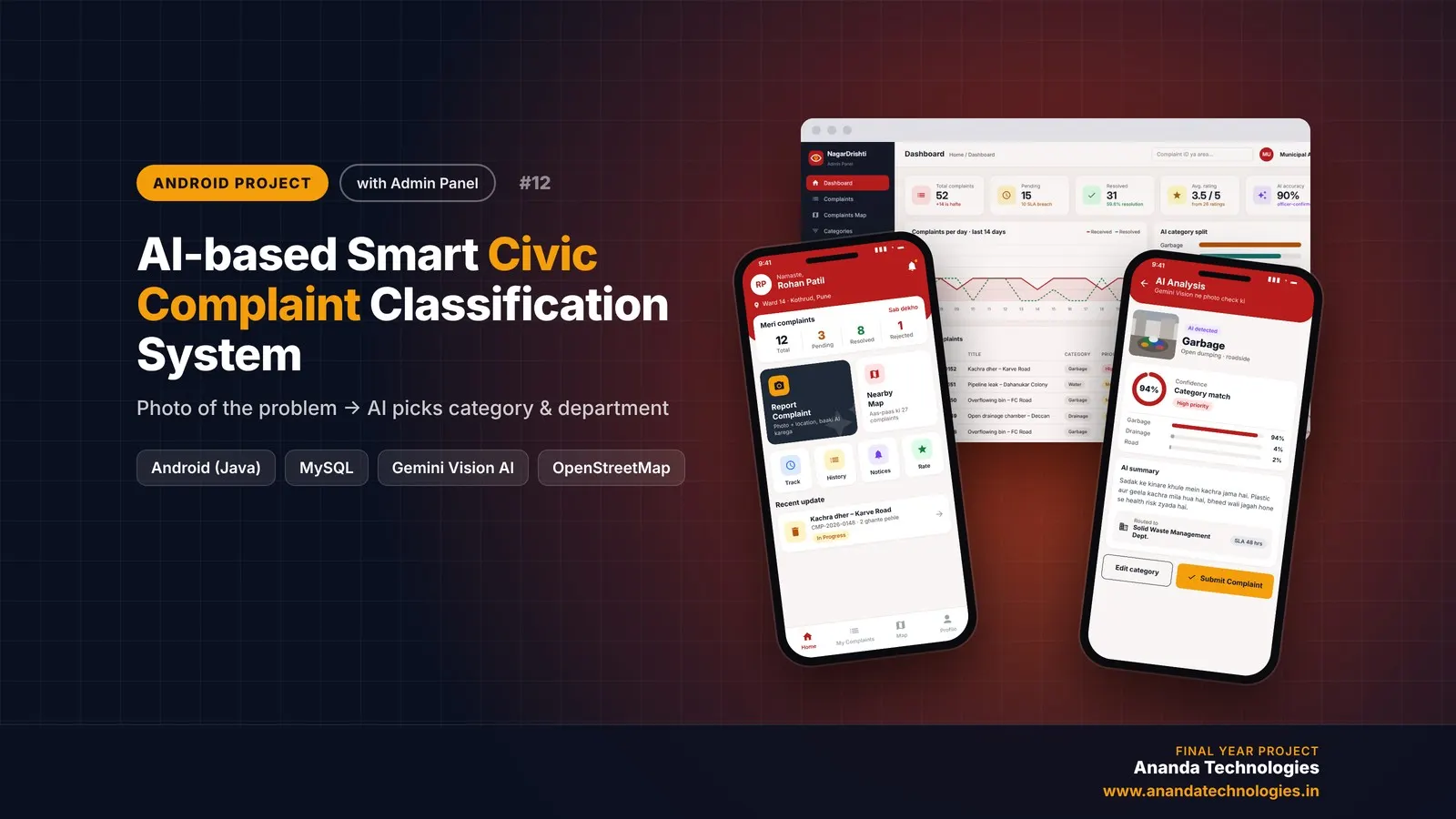
- AI civic complaint classification — classifies civic complaint photos with Gemini Vision and routes them to the right department, with SLA tracking. A good extension is a text classifier for complaint descriptions, with a confusion matrix in your results chapter.
AI for Healthcare and Deep Learning
- Skin disease detection using CNN — an on-device TensorFlow Lite skin scan with dermatologist review and booking. It suits Deep Learning and AI for Healthcare; report accuracy, precision and recall per class.
- Diabetic retinopathy detection — an attention-based EfficientNet model with Grad-CAM explanations. This is an M.Tech-depth, research-heavy build; choose it only if your group is comfortable with datasets, training and writing a strong results chapter.
- Medical report analysis using RAG — OCR plus retrieval-augmented generation that gives cited answers from a medical report, with Hindi output. Also M.Tech-depth, and a good fit if your department encourages a paper.
AI for Finance and Recommendation Systems
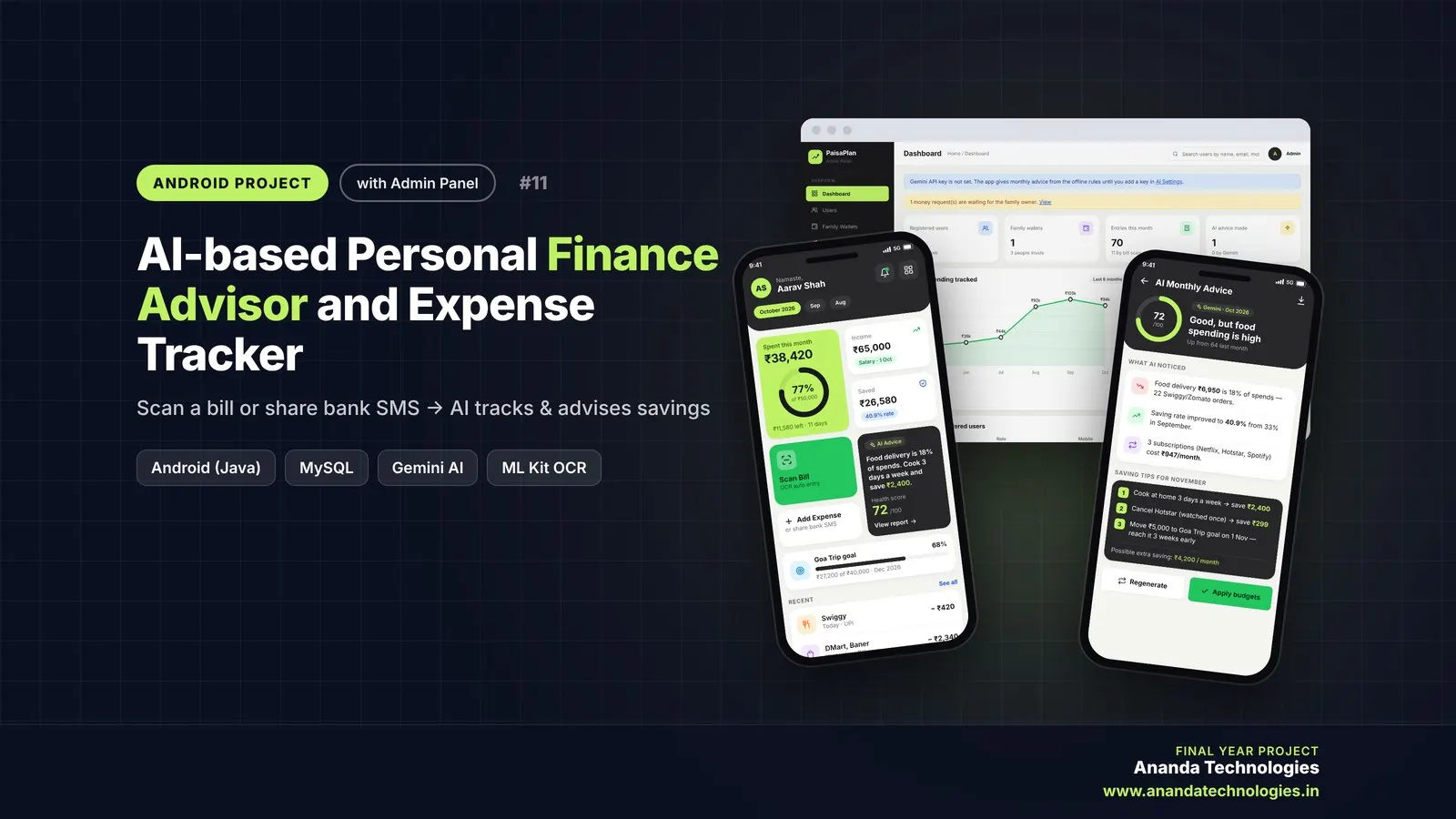
- AI personal finance advisor and expense tracker — bill scan OCR, SMS-based entry, budgets and AI advice. It links well with the AI for Financial & Banking Applications elective; you can add spending prediction as your ML module.
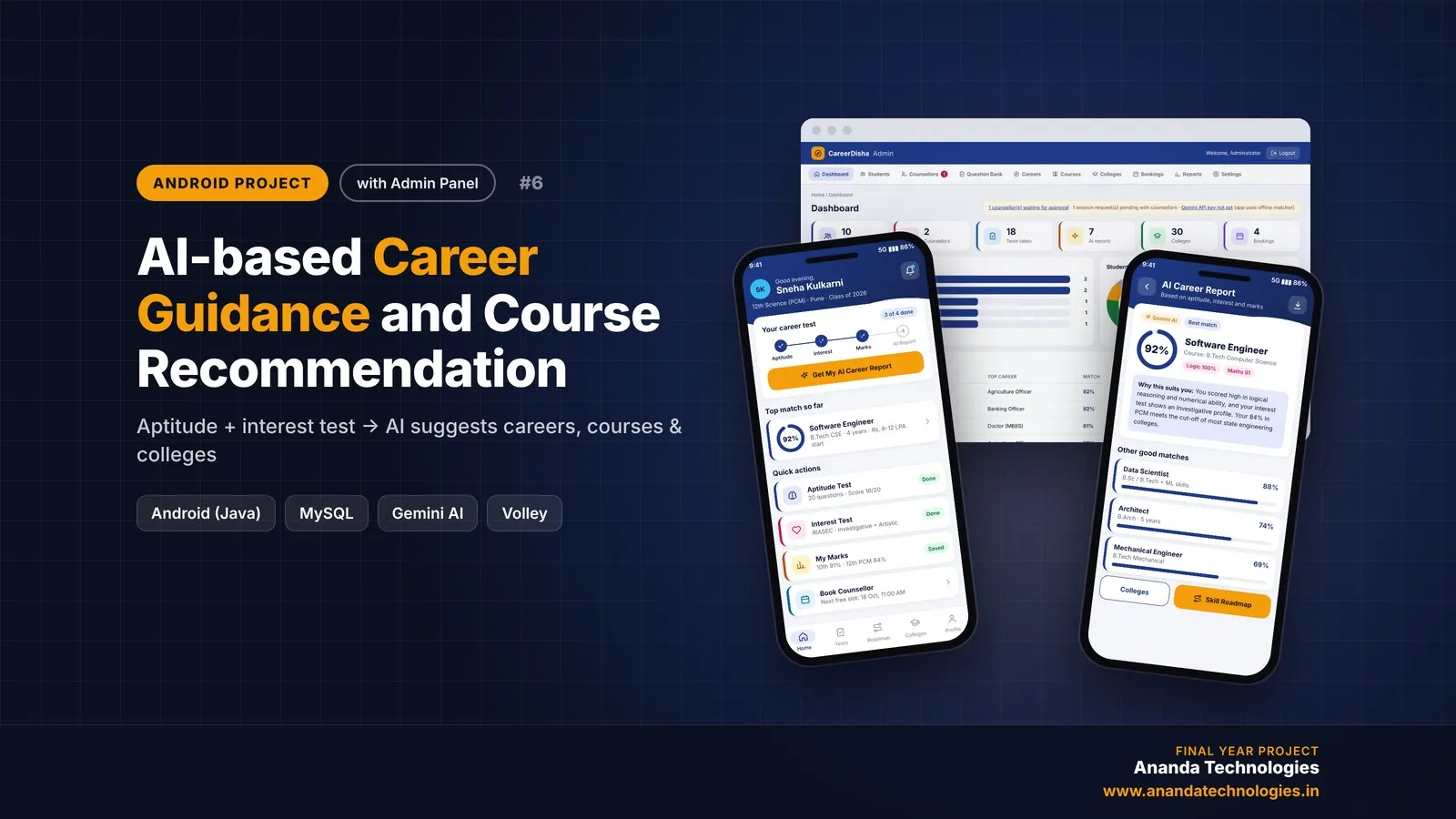
- AI career guidance and course recommendation — an aptitude and interest test with an AI career report and counsellor booking. For the Recommendation Systems elective, add a content-based or collaborative recommender and compare it with the AI-generated suggestions.
Machine Vision and assistive AI
- AI vision assistant for the visually impaired — voice-first scene description, text and currency reading, and SOS. Examiners usually value the social impact; measure response time and reading accuracy in different light conditions.
More options are in the AI and ML project list and the full BE/BTech project list.
API-based AI vs your own trained model
Many modern apps call a large language model API such as Gemini. That is fine and very practical, but an MU panel will ask, "What is your contribution?" A safe approach is:
- Use the API where it makes sense (chat, summaries, image description).
- Add at least one module you build and evaluate yourself — a classifier, a recommender or a fine-tuned model.
- Compare two or three methods in a table (for example, your model vs a baseline vs the API) using clear metrics.
This directly answers the "validation of results" and "innovation" parameters in the syllabus.
Tips for the Mumbai University AI project viva
- Know your dataset: source, size, classes, how you cleaned it and how you split training and test data.
- Explain one metric deeply: be ready to say why you used F1-score or recall instead of only accuracy.
- Keep the weekly log updated: the weekly log report is one of the listed term work items.
- Print the black book correctly: see our Mumbai University black book format post.
- Try a paper or competition: the syllabus encourages at least one technical paper and project competitions.
If you are comparing with Pune colleges, our AI and ML projects for SPPU students post covers the SPPU side.
Finding a ready AI project base in Mumbai
If your group wants a working base to study and extend, our final year projects in Mumbai page lists Computer, IT and AI projects with source code, report and setup help. Before you pay, you can see the free abstract, screenshots and a report preview of each project. Whatever you pick, run it yourself, add your own module and be ready to explain every line — that is what the examiner checks.
Frequently asked questions
Which AI ML projects suit Mumbai University BE/BTech students?
Projects that match your final year subjects work best, for example NLP, deep learning for healthcare, recommendation systems or AI for finance. The Major Project 2 guidelines ask for data details, performance evaluation parameters and validation of results, so pick a topic where you can measure and compare results.
How many marks does the Mumbai University Major Project carry for Rev-2019 'C' scheme students?
As per the official syllabus, CSP701 Major Project 1 in Semester VII has 3 credits and 75 marks (TW 50 + Oral & Practical 25), and CSP801 Major Project 2 in Semester VIII has 6 credits and 150 marks (TW 100 + Oral & Practical 50). Autonomous colleges may differ, so check your own scheme.
Is a project that uses the Gemini or ChatGPT API accepted as an AI project?
Many colleges accept API-based apps, but examiners will ask about your own contribution. Add at least one module you build and evaluate yourself, such as a classifier or recommender, and compare it with a baseline in your results chapter. Confirm the rules with your guide.
Can we see the AI project working before we pay?
We do not give a live demo before payment. You can check the free abstract, screenshots and a report preview of each project on the website before you decide, and after purchase we help you set it up and understand the code.