Final Year Projects
BE/BTech Computer Engineering Project Ideas for Mumbai University Students
BE/BTech Computer Engineering project ideas for Mumbai University students, mapped to Rev-2019 Sem VII and VIII subjects like ML, NLP, Blockchain and Deep Learning.
6 min read · updated
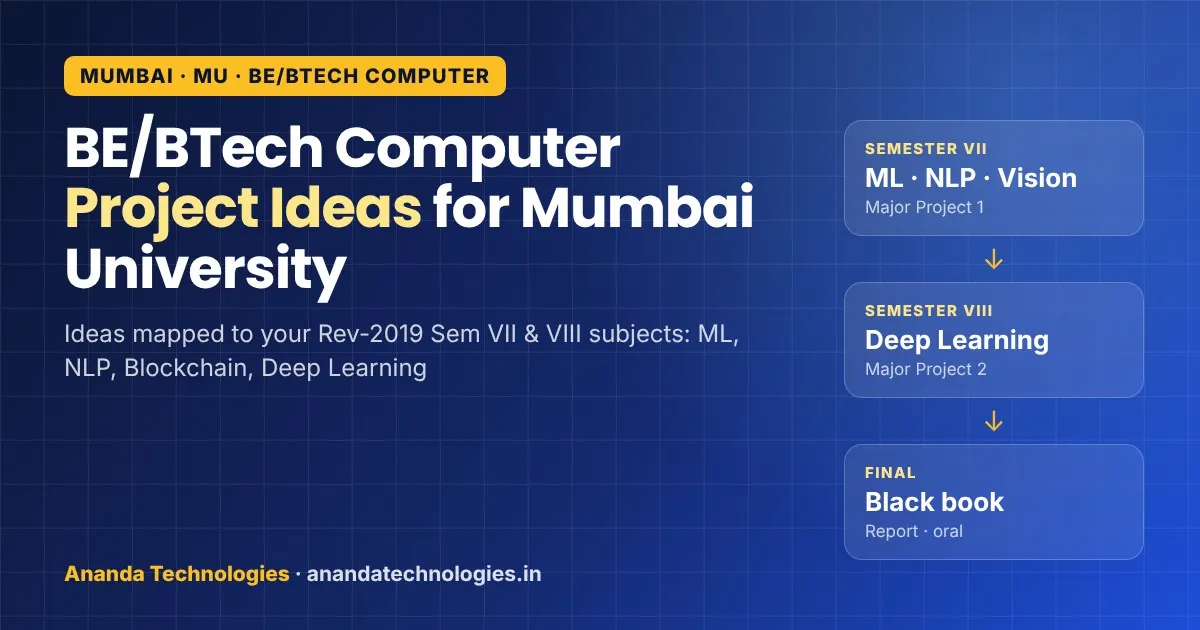
Looking for BE/BTech computer projects Mumbai University examiners will take seriously? The easiest way to choose is to start from your own syllabus. Under the Rev-2019 'C' scheme, final year Computer Engineering at the University of Mumbai is full of AI, data and security subjects, and a Major Project that grows out of one of them is easier to explain in reviews and in the oral.
This guide maps the Sem VII and Sem VIII subjects to project ideas, gives you a quick way to check if an idea is strong enough, and links real projects you can study. It is written for BE/BTech Computer Engineering students in Mumbai, Thane and Navi Mumbai colleges affiliated to MU. If your batch follows a newer NEP syllabus, check your own course list first, because codes and electives may differ.
What your final year looks like under Rev-2019
The official Rev-2019 'C' scheme syllabus for BE Computer Engineering (Sem VII and VIII with effect from 2022-23) has these parts that matter for your project:
| Semester | Core subjects | Department electives (choose one per slot) | Project |
|---|---|---|---|
| VII | CSC701 Machine Learning, CSC702 Big Data Analytics | DLOC-3: Machine Vision, Cyber Security, Natural Language Processing · DLOC-4: AR & VR, Blockchain, Information Retrieval | CSP701 Major Project 1 (3 credits) |
| VIII | CSC801 Distributed Computing | DLOC-5: Deep Learning, Digital Forensics, Applied Data Science · DLOC-6: Optimization in ML, High Performance Computing, Social Media Analytics | CSP801 Major Project 2 (6 credits) |
The project guidelines in the same syllabus say:
- Groups of at least 2 and at most 4 students.
- The topic can be product-based, application-based or research-based, or it can fill a gap in an existing system. Latest technologies are encouraged.
- Do not repeat work done in your college in the last three years.
- For problem ideas, the syllabus points to the Digital India portal, Smart India Hackathon (SIH) and other hackathon portals.
- Out-house projects at research institutes, organisations or industry are allowed.
Major Project 2 carries more weight than Major Project 1 (term work plus oral and practical), so pick a topic in Sem VII that you can keep building in Sem VIII. For the report side, see our Mumbai University black book format guide.
Project ideas mapped to your subjects
The ideas below are grouped by the subject they grow out of. Each one is a software project: no hardware kits are needed.
Machine Learning and Big Data Analytics (Sem VII core)
- Multi-disease risk prediction – train models on public health datasets for diabetes, heart and kidney risk and explain each result with SHAP values. Our multi-disease prediction project is built at M.Tech depth, so it suits a group that wants a research-heavy Major Project.
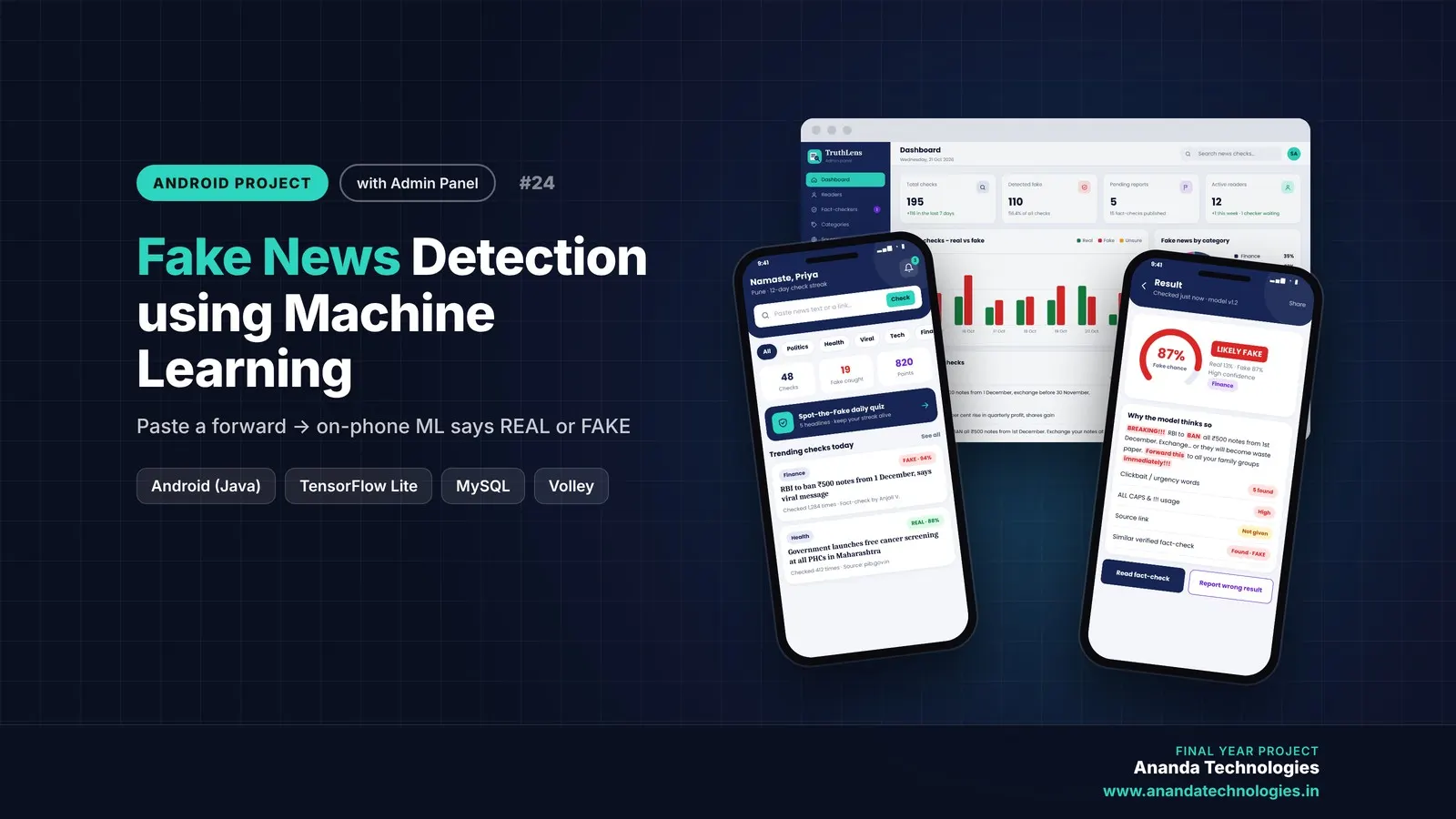
- Fake news detection – classify news text and add a review step by human fact-checkers. See the fake news detection project (Android with on-phone TFLite model).
- Log or sales analytics on a large dataset – a good Big Data Analytics extension if your lab already uses Hadoop or Spark. Keep the dataset public and cite it in the report.
Natural Language Processing and Information Retrieval (DLOC-3 / DLOC-4)
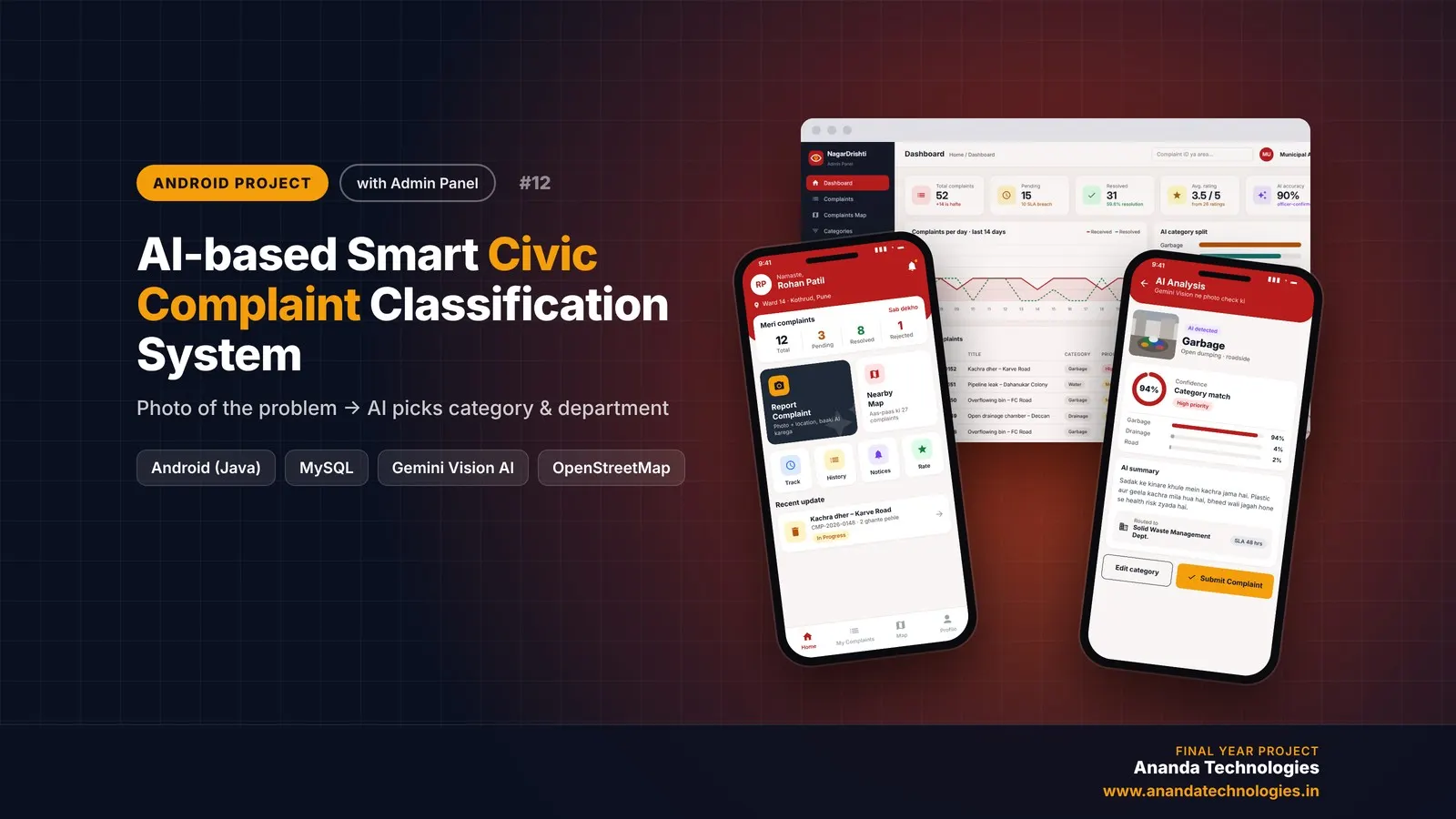
- Complaint classification and routing – read a citizen complaint (text or photo), predict the department and track it until it is closed. See the AI civic complaint classification system.
- Question answering over documents (RAG) – upload reports or PDFs, retrieve the right passages and give answers with citations. The medical report analysis using RAG project shows the full pipeline (OCR, hybrid retrieval, cited answers). It is also an M.Tech-level build.
Machine Vision and Deep Learning (DLOC-3 / DLOC-5)
- Medical image classification – a CNN or CNN-ViT model on public X-ray or skin images. Compare at least two models and report accuracy, precision and recall. See the chest X-ray pneumonia detection project and the lighter skin disease detection Android project.
Cyber Security and Digital Forensics (DLOC-3 / DLOC-5)
- Network intrusion detection – feature selection plus a boosted-tree model on standard intrusion datasets, with SHAP to explain alerts. See the network intrusion detection project.
- Phishing link and spam message checker – a classic topic, but you can make it new by adding Hindi/Marathi messages or a browser extension.
Blockchain, Distributed Computing and Social Media Analytics
- Certificate verification on a blockchain – store a hash of each certificate and let employers verify it with a QR code. Keep the scope small: one smart contract and a clean web front end.
- Social media sentiment dashboard – collect public posts on a topic, run sentiment and topic models and show trends over time. Mention data source rules and privacy in your report.
A full-stack product with an AI feature
Not every group wants a research topic. An application-based project is allowed, and it is often easier to demo well. A booking app with an AI step, such as the smart home services booking Android project (AI problem check, worker matching, OTP job start, admin panel), fits this route. Browse more in BE/BTech projects and AI and ML projects.
How to test if your idea is strong enough
Before you submit your topic, answer these five questions as a group:
- Which subject does it come from? Examiners like it when you can link the project to ML, NLP, Blockchain or another subject you studied.
- What is new? A different dataset, a local language, a better model, or a gap in an existing app. The syllabus asks you not to repeat the last three years' topics, so check your department's list.
- Can you show results? Plan tables and graphs: accuracy, response time, before/after comparison. These fill your results chapter.
- Can 2–4 people split it? For example: model, back end, front end, testing and report. Every member should be able to explain the whole flow in the oral.
- Will it run on a laptop? Very large models or paid APIs can fail on review day. Keep a version that runs offline or on free tiers.
A simple plan across Sem VII and Sem VIII
- Sem VII (Major Project 1): problem statement, literature survey, requirement analysis, design (UML or block diagrams), dataset collection and a first working prototype. Your college decides the review dates.
- Sem VIII (Major Project 2): complete build, testing, results and comparison, black book, and final oral. Many groups also try to publish a paper or join a hackathon with the same work.
For the stage-wise detail, read our Mumbai University Major Project I and II guide.
Common mistakes Mumbai students make
- Picking a topic only because it sounds new, without a dataset to train or test on.
- Using a pre-trained model without understanding it, then struggling in the viva.
- Leaving the black book for the last two weeks of Sem VIII.
- Building only a model with no interface. A simple web or Android front end makes the demo clear.
Need a ready base for your project?
If you are a BE/BTech Computer or IT student in Mumbai, Thane or Navi Mumbai, you can see our final year projects for Mumbai students. Every project page has a free abstract, screenshots and a report preview, so you can judge the topic before you decide. Pick something your whole group understands and can explain with confidence.
Frequently asked questions
Which subjects should BE/BTech Computer Engineering students at Mumbai University use for project ideas?
Under the Rev-2019 'C' scheme, Sem VII has Machine Learning and Big Data Analytics as core subjects, and electives such as Natural Language Processing, Machine Vision, Cyber Security, Blockchain and Information Retrieval. Sem VIII adds Distributed Computing and electives like Deep Learning and Social Media Analytics. A project that grows out of one of these is easier to explain in the oral.
How many students can be in a Mumbai University Major Project group?
The Rev-2019 BE Computer Engineering syllabus says a group should have at least 2 and at most 4 students. Your department may set its own rules within this, so confirm with your project coordinator.
Can I do an application-based project instead of a research project?
Yes. The syllabus allows product-based, application-based or research-based topics, or a topic that fills a gap in an existing system. Many groups build a full-stack web or Android app with an AI feature and show clear test results.
How do I make sure my project topic is not a repeat?
The syllabus asks students not to repeat work done in the last three years, so check your department's list of past topics. Add something new, such as a different dataset, a local language, a better model or a missing feature in an existing app.