
Websites & Apps
App or Website for Small Business? A Build-First Roadmap for Beed and Jalna
Should a Beed or Jalna business build an Android app or a website first? A four-stage roadmap: free basics, a website that brings calls, a staff app, and a customer app only when it pays off.
6 min read · updated
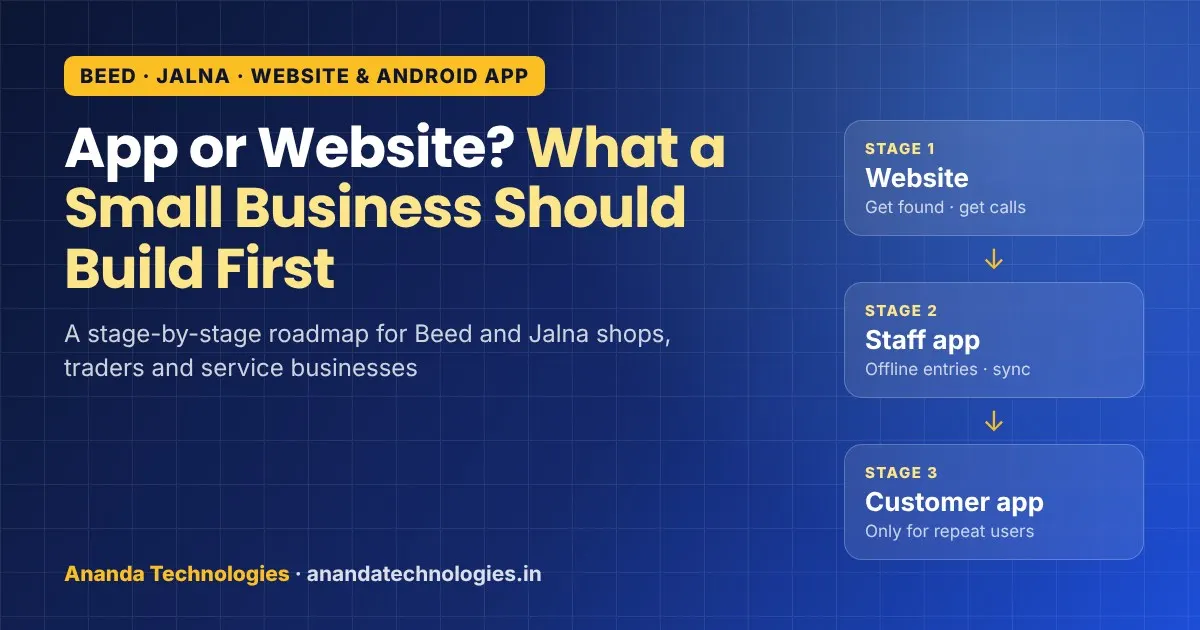
If you run a shop, clinic, agency or trading business in Beed or Jalna and keep asking "app or website for small business — which one first?", this guide gives you a step-by-step order to build in. The short version: most small businesses should not build both at once. Build in stages, so each step is paid for by the enquiries or time saved from the step before it.
Our 30 Oct post on Android apps for Nanded businesses compares apps and websites feature by feature. This post is different. It is a roadmap: what to do in month one, what to add later, and the signals that tell you it is time for the next step.
Start with one question: who will open it, and how often?
A website and an app solve different problems.
- A website is for people who do not know you yet. Someone in Ambajogai searches "steel dealer Jalna" or "seed shop near me", lands on your page, sees your address and phone number, and calls you. They may visit once.
- An app is for people who already know you and need you again and again: your collection agents every morning, your sales staff on dealer visits, or loyal customers who order every week.
Nobody installs an app for a business they visit twice a year. But a field agent who records 40 collections a day will happily use an app, because it saves them a diary and an evening of re-entry.
So the first step depends on whether your problem today is "new customers can't find us" (website) or "our own staff waste time on paper" (staff app).
The four-stage roadmap
Stage 0: free basics (before you pay any developer)
Before spending on development, set up what costs nothing:
- A Google Business Profile with your signboard name, correct address, phone number and timings. Our Google Business Profile guide explains how.
- WhatsApp Business with a catalogue, quick replies and your timings.
- One phone number used everywhere — signboard, visiting card, profile and WhatsApp.
For many small shops in Beed's talukas, this alone brings the first online enquiries. It also tells you what customers ask about, which becomes the content of your website later.
Stage 1: a simple website that brings calls
When customers search for you, or ask "do you have a website?", build a small business website first. For most shops and service businesses, five or six pages are enough: Home, Products or Services, About, Gallery, Contact with a map, plus a click-to-call and WhatsApp button on every page.
Why the website usually comes before the app:
- It works for everyone with a browser. No install, no storage, no update.
- Google can show it in search. An app inside the Play Store does not bring you local search traffic the same way.
- It is the base for everything later: your app's privacy policy, your Razorpay account and your Google profile all point to a website.
Read more on our website development service page.
Stage 2: an internal app for your own team
This is where an Android app earns its cost fastest — not for customers, but for staff. Good signs you are ready:
- Agents or salesmen write in a diary and someone types it again in the office.
- You cannot see today's collections or orders until staff return in the evening.
- Network is weak in the villages your team visits.
A staff app does not need to be on the Play Store at all. It can be shared as an APK to your team's phones, or published privately. It should save entries offline and sync when the network returns. See our Android app development service for how we build field and collection apps.
If your main problem is billing and stock at the counter, you may not need an app yet. Ready software like Ananda POS handles GST billing, stock and udhari on the shop computer.
Stage 3: a customer app (only when customers come back often)
A public customer app makes sense when the same customers return many times: weekly grocery or milk orders, a finance company's borrowers checking their balance, members of a coaching class, or dealers placing repeat orders.
Before this stage, check two things:
- Do your regular customers already ask for an easier way to order or check dues? If they are happy on WhatsApp, an app may not change much.
- Who will promote it? An app only helps if your staff ask every customer to install it.
Which first? A guide by business type
| Business (Beed / Jalna examples) | Build first | Add later, if needed |
|---|---|---|
| Retail shop, hardware, electronics | Google profile + website | Online orders on the website |
| Seed and fertiliser dealer | Website with product list and season updates | Staff app for dealer or farmer visits |
| Steel or industrial supplier (Jalna MIDC) | Website with product range and enquiry form | Sales team order app |
| Finance company / savkar with field agents | Staff collection app | Customer app for balance and dues |
| Clinic or diagnostic centre | Website with timings and booking form | Patient reports on the website or app |
| Fruit growers / FPO selling sitaphal or mosambi | Website + WhatsApp ordering | Buyer app for repeat bulk buyers |
| Coaching class | Website with courses and results | Student app for notes, tests and fees |
These are starting points, not rules. A finance business, for example, often starts with the staff app because its daily problem is collections, not new customers.
Local reasons this order works in Beed and Jalna
Jalna is known as the "Seed Capital of India" and for its steel industry, and it is a major mosambi (sweet lime) centre. Many of these businesses sell to dealers and buyers across Maharashtra. For them, a clear website with a product range and an enquiry form usually brings more value first than an app, because buyers from outside the city search before they call.
Beed has 11 talukas, including Ambajogai, Parli, Majalgaon, Georai and Ashti, and agriculture is the district's main business. Beed's custard apple (sitaphal) received a GI tag in 2016. Businesses here often have staff, agents or buyers spread across talukas with uneven mobile coverage. That makes an offline-capable staff app a strong second step once the website is live.
Play Store facts to plan for
If your Stage 3 app will be public on Google Play, plan time for these steps (from Google Play Console Help):
- A Google Play developer account has a one-time registration fee of US$25.
- Personal developer accounts created after 13 November 2023 must run a closed test with at least 12 testers opted in for 14 days in a row before applying for production access. Plan this into your launch date.
- Accounts are either personal or organisation. For a business app, open the account in your business's name, so the app stays yours.
We prepare the listing, screenshots and privacy policy and publish the app under your developer account, so you own it.
How we work with Beed and Jalna businesses
Our office is in Nanded. We work with businesses in Beed and Jalna by phone and WhatsApp, online meetings, and visits when needed. After a requirement call, you get a fixed written quotation. During the build, you see a demo every week on a test link. The domain, hosting, Play Store account and code are in your name. We also train your staff at launch.
If you are not sure which stage you are at, we can look at your current setup and tell you honestly whether you need a website, an app, both, or neither yet. Getting found on Google is part of the plan too — see our SEO and digital marketing service. If you plan to sell online later, read our e-commerce basics for Jalna and Beed.
Next step: contact us with what your business does and what problem you want to fix first. We will suggest the stage that fits.
Frequently asked questions
Should a small business build an app or a website first?
For most small businesses a website comes first, because it helps new customers find you on Google and works in any browser without an install. An Android app makes sense first only when your daily problem is your own staff's work — for example collection agents or salesmen writing in diaries.
Can a staff app be used without publishing it on the Play Store?
Yes. An internal app for your own team can be shared as an APK or published privately. A public Play Store listing is needed mainly for customer apps.
What does Google Play need before a new app goes live?
A developer account with a one-time US$25 registration fee. Personal accounts created after 13 November 2023 must also run a closed test with at least 12 testers opted in for 14 days before applying for production access (Google Play Console Help). For a business, open the account in the business's name.
Do you work with businesses in Beed and Jalna?
Yes. Our office is in Nanded, and we work with Beed and Jalna businesses by phone and WhatsApp, online meetings and visits when needed. You get a written quotation after a requirement call, weekly demos, and the domain, hosting, Play account and code in your name.