
Websites & Apps
Does Your Nanded Business Need an Android App? When It Helps and When It Doesn't
An Android app is worth it when staff or regular customers use it every day. Here is when an app helps a Nanded business, when a website is enough, and what to ask before you build.
6 min read · updated
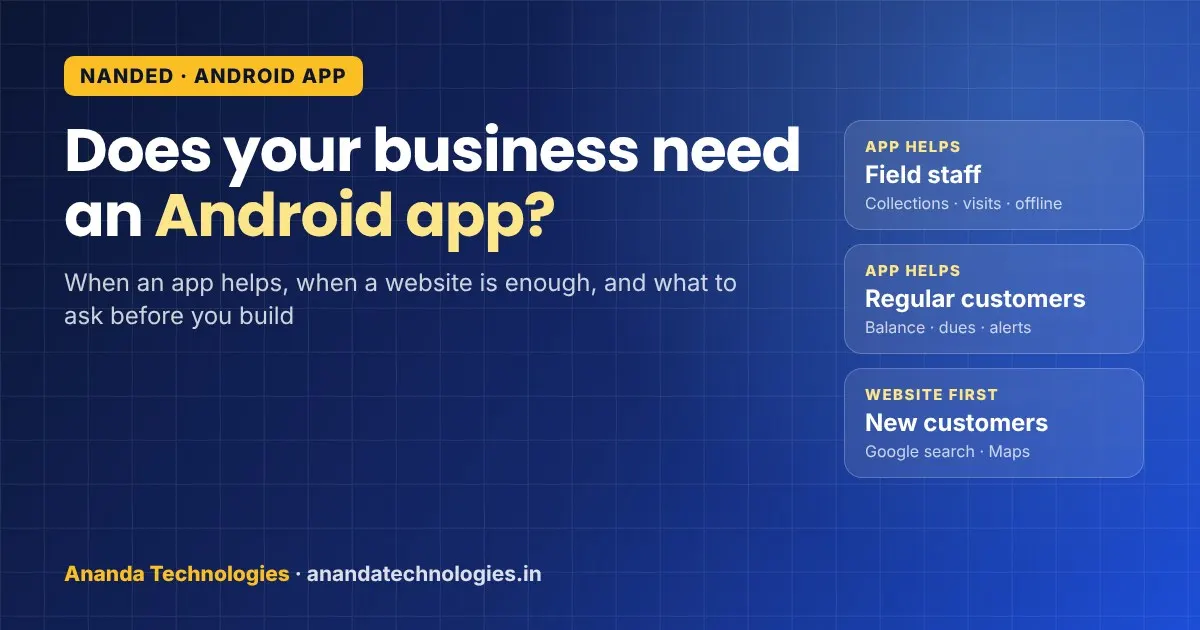
Every few weeks a business owner in Nanded asks us the same question: "Should we make an app?" Sometimes the honest answer is yes. Often it is "not yet — fix your website, your billing or your WhatsApp process first." An Android app costs time and money to build, publish and keep updated, so it should solve a real daily problem, not just look modern.
This guide helps you decide. It is written for shop owners, finance and collection businesses, clinics, coaching classes, traders in the New Mondha market area, hotels and travel agents serving Hazur Sahib pilgrims, and units in the Nanded, Krushnoor, Loha, Degloor, Dharmabad and Kinwat industrial estates.
First, ask: who will open the app every day?
An app only pays off if someone opens it again and again. Before anything else, write down who will use it and how often.
- Your own staff (collection agents, field sales, delivery boys, site supervisors) — they open it daily because it is part of their job. This is where Android apps work best.
- Regular customers or members (loan customers, chit group members, students, patients on follow-up) — they open it to check a balance, a due date or a result. Useful if they do this every week or month.
- One-time visitors (a pilgrim booking a room once, a person looking for a shop) — they will almost never install an app. A fast website and a Google Business Profile serve them better.
If your answer is mostly the third group, stop here and read our guide on how to choose a website developer instead.
When an Android app clearly helps
1. Field staff and daily collections
Many Nanded finance businesses, savkars and chit groups still have agents writing collections in a diary, and the office enters everything again in the evening. That means double work, late figures and room for mistakes. A collection app lets the agent record the payment on the spot, share a receipt on WhatsApp, and see today's due list. The owner sees who collected how much without waiting for the evening.
The key point for our region: network is weak in many villages around Nanded, Mukhed, Kandhar and Hadgaon. An online-only app stops working there. The app must save entries on the phone and sync when the signal comes back. Ask any developer directly: "Will this work with no internet?"
2. Customers who keep calling you
If your staff spends hours answering "What is my balance?", "When is my next instalment?" or "Is my report ready?", a simple customer app (or a customer login on your website) can answer it for them, with push notifications for due dates.
3. Work that needs photos, location or signatures
Site visits, stock checks at dealers, survey work, delivery proof — a phone app can capture a photo with date, time and GPS location and send it to the office. Paper and WhatsApp photos get lost; app entries stay linked to the right customer or job.
When an app is NOT the right first step
Be honest with yourself here. An app is usually the wrong first spend when:
- You do not have a website or Google Business Profile yet. Most new customers find you on Google first. Start there.
- Your office software is still on paper or Excel. An app needs a main system to send data to. Fix billing, stock or loan records first — ready software like Ananda POS for shops or Ananda Lend for lending may already cover it.
- The app would only show your products or contact details. That is a website's job. People will not install an app just to see your rate list.
- Nobody will update it. Android versions and Play Store rules change every year. An unmaintained app stops working or gets removed.
App, website or both? A quick comparison
| Need | Better choice | Why |
|---|---|---|
| New customers finding you on Google | Website + Google profile | No install needed, shows in search and Maps |
| Agents entering collections in villages | Android app | Works offline, syncs later, uses phone camera and GPS |
| Customers checking balance or dues | App or customer login on website | App if they check often; web login if rarely |
| Showing products, rates and contact | Website | Easy to share on WhatsApp, no install |
| Online payments and orders | Website first, app later | Website reaches everyone; app for repeat buyers |
| Staff attendance and visit reports | Android app | Location, photo and time stamp on each entry |
Many businesses end up with both: a website for new customers and an Android app for staff or regular customers, both connected to the same software. If you are deciding between ready-made and fully custom systems, our guide on custom vs ready software explains the trade-offs.
Questions to ask before you build any app
Whoever you hire, get clear answers to these in writing:
- What exactly will the app do on day one? Keep the first version small — 5 to 10 screens that solve the main problem. Add more after your staff uses it.
- Does it work offline? Essential for field work around Nanded district.
- Is it in Marathi? If your agents or customers are more comfortable in Marathi, the app should be in Marathi, English or both.
- Who owns the Play Store listing and code? The app should be published under your Google Play developer account, with code handed over as agreed. Otherwise you are stuck if you change developers.
- What admin panel do I get? The office needs a screen to see entries, reports and export data.
- Will it connect to my existing software? Check this before signing, not after.
- What happens after launch? Ask about bug fixes, Android updates and Play Store policy changes — and whether there is an AMC.
How we approach Android apps at Ananda Technologies
Our office is in Nanded (1st floor, APMC Complex, New Mondha), so for Nanded businesses we can meet in person to understand how your work runs today. Here is how a typical project goes:
- Requirement call or visit — we note how your staff works now and what is going wrong.
- Written scope and fixed quotation — usually 50% advance and the balance linked to milestones. We do not quote prices before understanding the requirement, because every app is different.
- Clickable screen prototype — you check the flow on a phone before coding starts.
- Weekly test builds — your staff tries the APK on real phones and we improve it.
- Launch, training and support — published on Play Store under your account, staff trained, fixes after launch.
We build in Android (Kotlin/Java) and Flutter, with offline storage and background sync, push notifications and PHP/Laravel or Node backends. See the full details on our Android app development page. If you need the office-side system as well, look at custom software development, or our software company in Nanded page for everything we do locally.
A simple decision rule
If your staff or regular customers would use it every day or every week, and it would remove paper, calls or double entry, an Android app is worth discussing. If not, put your money into a good website and Google presence first — and come back to the app when the need is clear.
Not sure which one your business needs? Contact us with a few lines about your work. We will tell you honestly whether an app makes sense now, later, or not at all.
Frequently asked questions
Does every business in Nanded need an Android app?
No. An app makes sense when your staff or regular customers will open it every day or every week, for example collection agents, field staff or loan and chit members. If most of your customers find you once on Google, a fast website and a Google Business Profile are a better first step.
Will an Android app work in villages with poor network?
It can, if it is built offline-first. The app saves entries on the phone when there is no signal and syncs with the office software when the network returns. Ask your developer about this before you sign.
Can the app be in Marathi?
Yes. An app can be built in Marathi, English or both, which helps field staff and customers in Nanded and Marathwada use it comfortably.
Who should own the app on the Play Store?
You should. The app should be published under your own Google Play developer account, with the source code handed over as agreed, so you are not locked in if you change developers later.