
Business Software
Money Lending Software for Marathwada: Records, Receipts and the 2026 Law
A practical guide for licensed lenders in Nanded, Latur and Beed: what the Maharashtra Money-Lending Act expects from your books, what changed in 2026, harvest-season repayments, field agents and the questions to ask in a software demo.
6 min read · updated
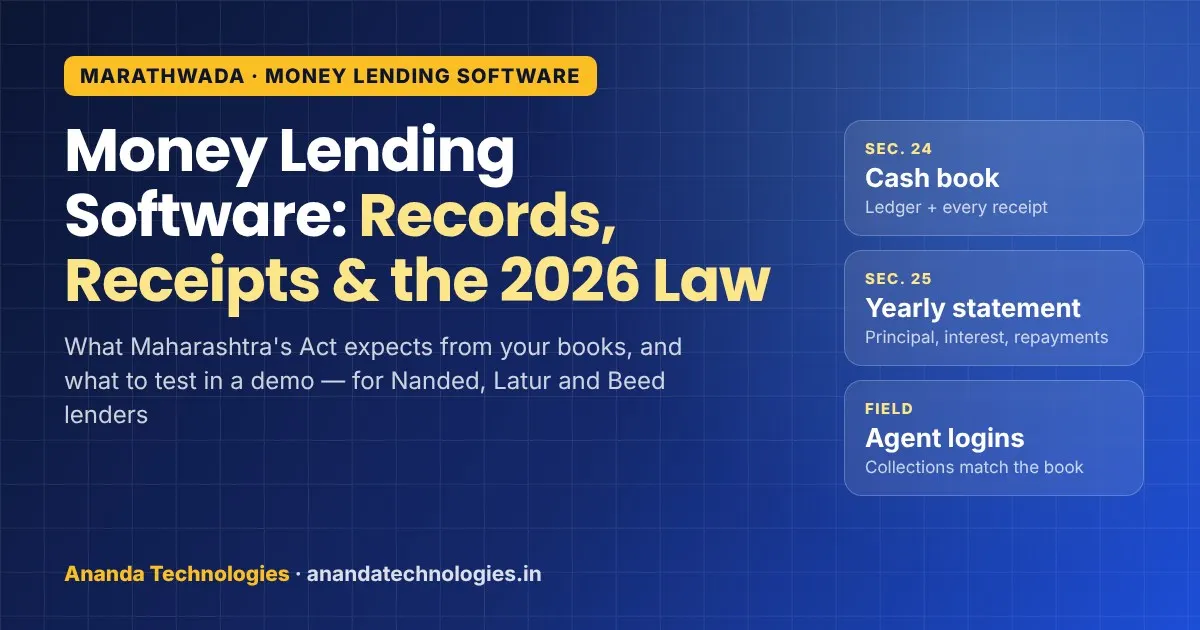
When lenders look for money lending software Marathwada offices can actually run, most demos show the same things: an EMI screen, a dashboard and a few charts. That is not enough here. A licensed saavkar in Nanded, a finance office in Latur or a family lending business in Beed has to keep records that Maharashtra's money lending law expects, collect from borrowers spread across talukas, and handle repayments that follow the farm season. This guide looks at lending software from that side: what your books must show, what changed in 2026, and what to test before you buy.
This is general information, not legal advice. Confirm what your licence requires with your CA or lawyer.
Why records matter more in 2026
Two things happened this year that every Marathwada lender should know about.
First, the state amended the Maharashtra Money-Lending (Regulation) Act, 2014. The Amendment Act, 2026 was notified in July and raises the punishments for lending without a valid licence and for molesting a debtor during recovery. The government's stated reason is that some people keep doing illegal money lending even after earlier action.
Second, on 29 October 2026 the Supreme Court, hearing a matter about Maharashtra, noted that under the 2014 Act an advance against a promissory note is a loan, and that a Maharashtra lender recovering such a loan has to show a valid money lending licence at the very start of a cheque-bounce or recovery case.
The message for licensed lenders is simple: your licence and your books are your protection. If a dispute reaches court, the Act tells the court to first check whether the lender kept accounts and gave statements as required (sections 24 and 25). If not, the court can disallow interest. Clean records are not paperwork for its own sake. They are what lets you recover your money.
What the Act expects your books to show
Here is a plain summary of the record-keeping sections of the 2014 Act, and what each means for software.
| What the Act asks (2014 Act) | What your software should make easy |
|---|---|
| Keep a cash book and a ledger (sec. 24(1)) | Every receipt and payment entered once, with day-wise cash book and borrower-wise ledger |
| Give the borrower a statement within 30 days of a loan: amount, date, maturity, security, names, rate of interest (sec. 24(2)) | A loan sheet printed or sent when the loan is made, with all these fields filled in |
| Give a plain and complete receipt for every payment received (sec. 24(4)) | A receipt number for every collection, printed or on WhatsApp |
| Give a signed receipt for any pledged article, with description and estimated value, and keep duplicates in a separate register (sec. 24(5)) | A pledge register for gold and other articles, linked to the loan |
| Give each borrower a yearly statement of principal, interest, loans and repayments (sec. 25) | A borrower statement for any date range, so the yearly statement is quick to prepare |
| No compound interest, no rate above the government's notified maximum, and total interest never more than the principal (sec. 31) | Simple interest only, a rate check on new loans, and a warning when interest due nears the principal |
The exact forms are in the Maharashtra Money-Lending (Regulation) Rules, 2014. Ask your CA which formats apply to you, then check in the demo that the software can print them, or something close enough that your CA is satisfied.
How lending in Nanded, Latur and Beed is different
Repayments follow the harvest
Many borrowers in Nanded, Latur and Beed districts earn mainly from farming. Their cash comes in when soybean, cotton and tur reach the market, not in neat 30-day cycles. A good system should let you set up a loan with a lump-sum repayment after harvest, monthly interest with principal later, or weekly and daily collections for traders, and show all of them on the same due list.
Borrowers are spread across talukas
A lender in Nanded city may have borrowers in Ardhapur, Mudkhed and Loha; a Beed office may lend in Georai, Majalgaon or Ambajogai. That means field agents. When an agent comes back in the evening, his cash should match what the book says he collected. Software that records every collection under the agent's own login, with a receipt number, turns a two-hour evening reconciliation into a five-minute check.
More than one place means more than one licence
Under section 5 of the Act, a lender who works from more than one place applies separately for each place. If you have, say, an office in Latur city and another in Udgir, your software should keep each office's loans, cash and reports apart, while you as the owner can still see the total.
Marathi on paper
Section 24 allows statements in any recognised language. Many borrowers in rural Marathwada are more comfortable reading Marathi. Ask whether receipts and statements can be printed in Marathi, or at least with Marathi names, before you choose.
Ready software or custom software?
Most lenders do not need software built from scratch. A ready product covers the common work: borrowers and guarantors, loans with automatic interest and EMI, collections, receipts on WhatsApp, a morning due list and owner reports. Our Ananda Lend is built for exactly this, runs on your own office computer, comes with a 7-day free trial, and setup with staff training usually takes 1–2 days.
Custom work makes sense when your business has something unusual, for example a credit society with its own share and deposit rules, many branches that need to share data, or a separate phone app for field agents. In that case, our custom software development team builds around your process, and an Android app for collections can be added that keeps working on weak networks in villages. For the general trade-offs, read our guide on custom software vs ready software.
Questions to ask in any demo
Take one real loan from your register to the demo, with its part payments and late payments, and ask:
- Does the balance match my register to the rupee? If not, ask why before anything else.
- Is the interest simple interest, and can I see how it was worked out? You should be able to explain every figure to a borrower.
- What happens when a borrower pays only part of the interest? Check that the receipt clearly shows what was adjusted to interest and what to principal.
- Can I print the loan statement and the yearly statement? Compare them with the points in the table above.
- Where is the data kept and how is it backed up? Your loan book should never live on only one machine.
- Can each staff member and agent have their own login? You should always know who entered what.
- Who helps us enter our running loans? Entering opening balances is the hardest part of the switch.
If you are still on paper, our earlier checklist on moving your money lending register from paper to software covers the switch step by step, including running paper and software side by side for a month.
Talk to us
Ananda Technologies works from Nanded (1st floor, APMC Complex, New Mondha) and serves lenders across Marathwada, including Latur and Beed, by phone, WhatsApp, online meetings and visits when needed. We give a fixed written quotation after a requirement call, and your data stays in your own office. If you lend in Nanded or Latur, you can also see what we do locally on our software company in Nanded and software company in Latur pages.
Want to see your own loans in the software? Contact us for a free demo of Ananda Lend.
Frequently asked questions
Does money lending software replace the registers my licence needs?
Software can keep the cash book, ledger, receipts and borrower statements in one place, but the exact forms are set by the Maharashtra Money-Lending (Regulation) Rules, 2014. Show the printouts to your CA and confirm they meet your licence requirements.
Can the software handle borrowers who repay after the harvest?
It should. Ask in the demo for a loan with a lump-sum repayment after harvest, one with monthly interest and principal later, and one with weekly collection, and check that all three appear correctly on the due list.
I lend from Nanded and also from another town. Can one system handle both?
Under the Act each place of business needs its own licence, so keep each office's loans, cash and reports separate in the software while the owner sees the combined total. Ask the vendor to show this with two offices in the demo.
Is Ananda Lend only for Nanded lenders?
No. Our office is in Nanded, and we serve lenders across Marathwada, including Latur and Beed, by phone, WhatsApp, online meetings and visits when needed. You can try Ananda Lend free for 7 days.